
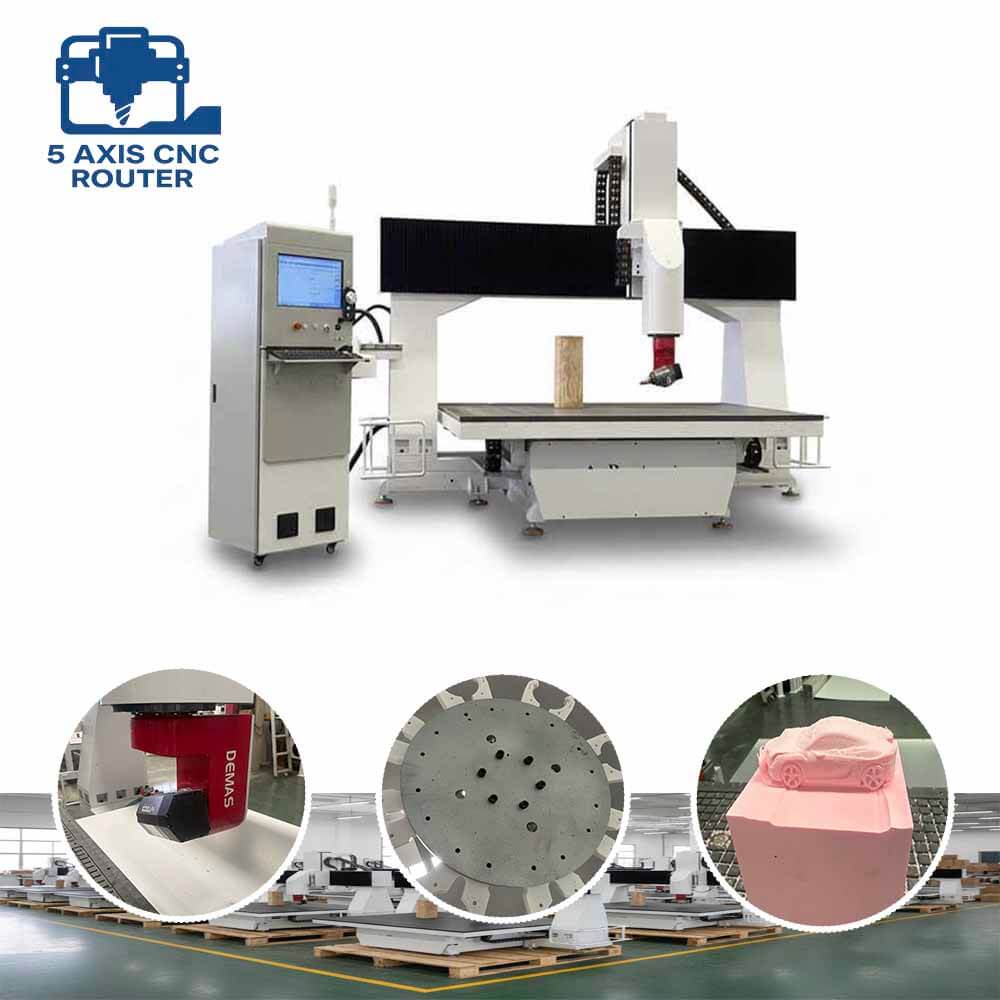
3+2 Axis vs True 5 Axis CNC Router: Which One Should You Choose?
Choosing between a 3+2 axis CNC router and a true 5 axis CNC router is one of the most important decisions buyers face when investing in multi-axis CNC equipment.
Both machine types are often marketed as “5 axis CNC routers,” yet their capabilities, cost, and ideal applications are very different. Selecting the wrong configuration can lead to unnecessary expense—or worse, limited production capability.
In this guide, we will clearly explain the differences between 3+2 axis and true 5 axis CNC routers, compare their costs and applications, and help you determine which machine is the right choice for your business.
Table of Contents
What Is a 3+2 Axis CNC Router?
A 3+2 axis CNC router operates with three linear axes (X, Y, Z) and two rotary axes that tilt or rotate the spindle to a fixed angle.
Once the spindle reaches the required angle, it locks in position, and machining continues using the three linear axes only.
Key Characteristics of 3+2 Axis CNC Routers
- Fixed-angle machining
- No simultaneous 5-axis movement
- Simpler control logic
- Lower machine cost
Typical Applications
- Woodworking and furniture manufacturing
- Foam cutting and pattern making
- Mold machining
- Model and prototype production
For many industries, a 3+2 axis CNC router provides excellent flexibility at a reasonable cost.
What Is a True 5 Axis CNC Router?
A true 5 axis CNC router allows all five axes to move simultaneously during machining. This enables continuous tool orientation changes and makes it possible to machine extremely complex shapes in a single setup.
Key Characteristics of True 5 Axis CNC Routers
- Continuous multi-axis motion
- Advanced CNC controller required
- Higher mechanical precision
- Higher cost
Typical Applications
- Aerospace components
- Marine and yacht manufacturing
- Complex composite parts
- High-end mold and die production
True 5 axis machining is essential when surface quality, accuracy, and geometric complexity are critical.
Key Differences: 3+2 Axis vs True 5 Axis CNC Router
1. Machining Capability
-
3+2 Axis:
Excellent for angled features, undercuts, and multi-face machining, but not ideal for complex curved surfaces. -
True 5 Axis:
Perfect for free-form surfaces, deep cavities, and complex geometries requiring constant tool orientation.
2. Programming Complexity
-
3+2 Axis:
Easier to program and simulate. Many standard CAM systems support 3+2 axis machining with simpler workflows. -
True 5 Axis:
Requires advanced CAM software, experienced programmers, and careful collision avoidance.
3. Machine Cost
-
3+2 Axis CNC Router:
More affordable initial investment
Lower maintenance costs -
True 5 Axis CNC Router:
Higher initial cost
More expensive components and service
In most cases, a true 5 axis CNC router costs 30–60% more than a 3+2 axis configuration with similar working size.
4. Accuracy and Surface Quality
-
3+2 Axis:
Good accuracy for most industrial applications, especially with proper setup. -
True 5 Axis:
Superior surface finish, especially on complex curves and organic shapes.
5. Setup Time and Efficiency
-
3+2 Axis:
Requires fewer setups than 3-axis machines but may still need multiple repositioning steps. -
True 5 Axis:
Can machine complex parts in a single setup, significantly reducing production time.
Cost Comparison Table
| Feature | 3+2 Axis CNC Router | True 5 Axis CNC Router |
|---|---|---|
| Initial Cost | Lower | Higher |
| Programming Difficulty | Moderate | High |
| Machining Complexity | Medium–High | Very High |
| Typical Industries | Wood, foam, molds | Aerospace, composite |
| ROI Speed | Faster for most users | Faster for complex parts |
Which Industries Benefit Most from a 3+2 Axis CNC Router?
A 3+2 axis CNC router is usually sufficient if you work in:
- Woodworking and furniture production
- Foam and mold manufacturing
- Sign making and model processing
- General industrial routing
For these applications, the added cost of a true 5 axis machine often does not translate into proportional returns.
When Is a True 5 Axis CNC Router the Better Choice?
You should strongly consider a true 5 axis CNC router if:
- Parts have complex free-form surfaces
- Single-setup machining is critical
- Tight tolerances are required
- Production throughput must be maximized
In these situations, the higher investment can be justified by reduced labor and improved quality.
Common Buyer Mistakes to Avoid
Mistake 1: Buying True 5 Axis “Just in Case”
Many buyers invest in true 5 axis machines they rarely use to full capacity.
Mistake 2: Underestimating Programming Requirements
Advanced machines need skilled operators and proper CAM software.
Mistake 3: Ignoring Future Production Needs
A machine should match not only current projects but also realistic future growth.
How to Choose the Right Option for Your Business
Ask yourself these questions:
- What materials and geometries do I machine today?
- How complex are my parts?
- Do I have qualified 5 axis programmers?
- What is my budget and expected ROI?
In many cases, a high-quality 3+2 axis CNC router offers the best balance of cost and capability.
Manufacturer’s Advice: Configuration Matters More Than Axis Count
From a manufacturer’s perspective, the performance of a CNC router depends more on:
- Machine rigidity
- Controller quality
- Spindle selection
- Matching configuration to application
A properly configured 3+2 axis CNC router can outperform a poorly configured true 5 axis machine in real-world production.
Final Verdict: 3+2 Axis or True 5 Axis?
There is no one-size-fits-all answer.
- Choose 3+2 axis if you want flexibility, affordability, and easy operation
- Choose true 5 axis if your parts demand continuous multi-axis motion
The right decision depends on application, budget, and long-term production goals.
Get Expert Advice Before You Buy
Before investing in a 3+2 axis or true 5 axis CNC router, it is strongly recommended to consult an experienced manufacturer.
Contact us to receive professional advice and a customized CNC solution that fits your production needs and budget.
Products Categories
Recently News


Why Choose Us
1.Experienced CNC manufacturer.
2.Strong R&D and innovation.
3.High-quality machine components.
4.Custom solutions available.
5.Strict quality control.
6.Fast production and delivery.
7.Professional technical support.
8.Competitive factory pricing.
9.Trusted by global customers.
10.One-stop CNC solutions.
Contact Us
- Wechat: ExtraCNC
- Whatsapp/Moblie:0086 15562628072
- Email: [email protected]
 EN
EN  AR
AR  EO
EO  IT
IT  DE
DE  KO
KO  JA
JA  RU
RU  AZ
AZ  BG
BG  CS
CS  DA
DA  EL
EL  ES
ES  FR
FR  ID
ID  LV
LV  NL
NL  ML
ML  PT
PT  TT
TT  SL
SL  TH
TH  UZ
UZ  UK
UK  SV
SV  TR
TR