
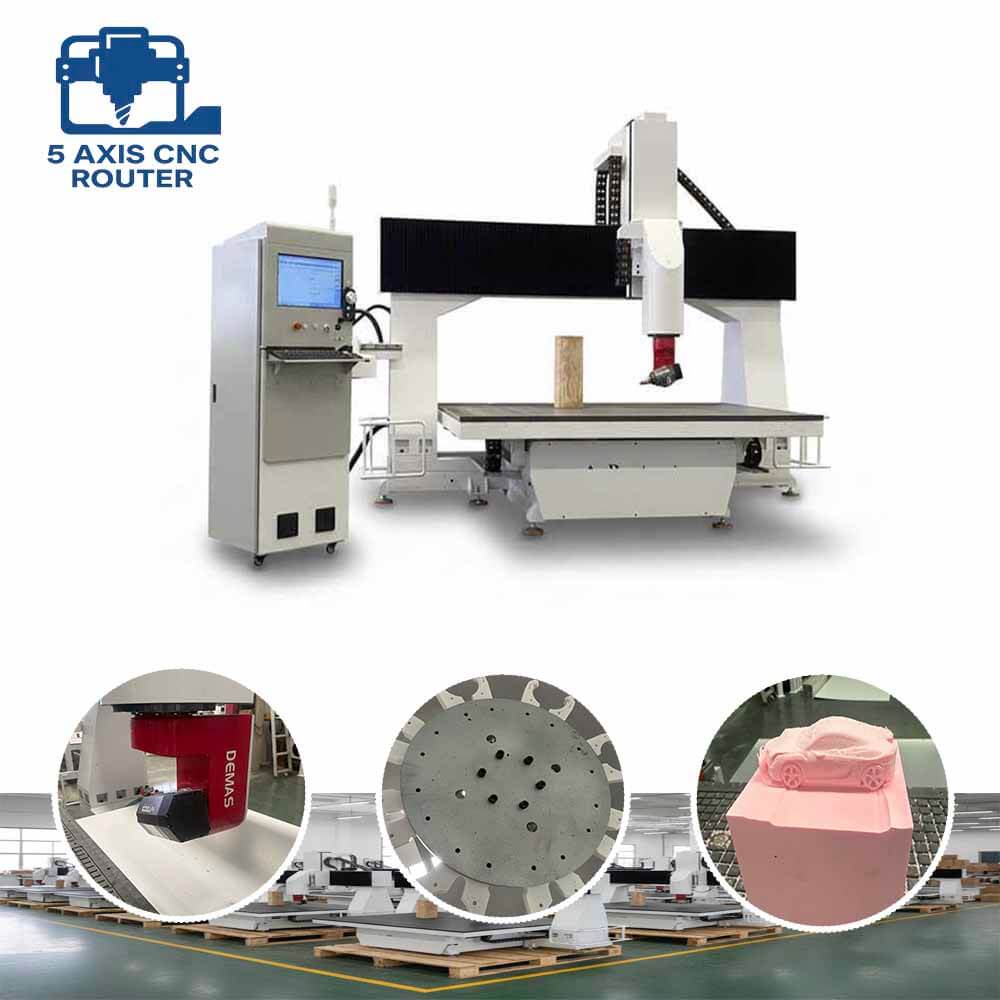
5 Axis CNC Router Specifications That Actually Matter
Specification sheets for 5 axis CNC routers often appear comprehensive, listing dozens of parameters such as spindle power, travel range, positioning accuracy, and control systems. However, not all specifications have equal impact on real-world machining performance.
From an engineering and production perspective, some specifications directly determine accuracy, stability, and repeatability, while others are secondary or even misleading when viewed in isolation. This article focuses on which 5 axis CNC router specifications actually matter, why they matter, and which ones should be interpreted cautiously.
The goal is to help manufacturers and engineers evaluate machines based on process performance, not marketing claims.
Table of Contents
Machine Structure and Mechanical Rigidity
Frame Design and Material
The machine frame is the foundation of all machining performance. A rigid structure minimizes deflection under cutting loads and ensures consistent positioning across the working envelope.
Key considerations include:
- Welded steel vs. cast structures
- Gantry mass and cross-section
- Stress-relief treatment after welding
For 5 axis CNC routers, rigidity is even more critical due to the additional forces introduced by tilted tool orientations.
Axis Support and Bearing Configuration
Linear guides and bearing arrangements affect:
- Load distribution
- Motion smoothness
- Long-term wear characteristics
Wide-spaced linear rails and properly preloaded bearings improve stability, especially during simultaneous multi-axis movement.
Rotary Axis Design (A / C or B Axis)
Rotary Axis Load Capacity
Rotary axes must support not only the workpiece or spindle weight but also dynamic cutting forces. Insufficient load capacity leads to:
- Positioning errors
- Surface finish degradation
- Premature mechanical wear
Manufacturers should evaluate rotary axis torque and stiffness rather than focusing only on rotational speed.
Positioning Accuracy and Repeatability
Rotary axis accuracy directly affects surface quality on complex geometries. Look for:
- High-resolution encoders
- Backlash compensation
- Thermal stability
Nominal accuracy values are less meaningful without repeatability and stability over time.
Spindle Specifications: Beyond Power Ratings
Spindle Power vs. Torque Curve
Spindle power alone does not determine cutting performance. The torque curve across the operating speed range is far more important.
High-torque performance at lower RPMs is critical for:
- Aluminum machining
- Deep cutting passes
- Larger tool diameters
A high-power spindle with poor torque delivery may underperform in real machining conditions.
Spindle Interface and Tool Holding
Tool holding affects:
- Runout
- Vibration
- Surface finish
Industrial 5 axis CNC routers typically use:
- HSK
- ISO
- BT tool holders
Consistent tool change repeatability is essential for multi-axis machining accuracy.
CNC Control System and Motion Processing
Multi-Axis Interpolation Capability
True 5 axis machining requires a controller capable of smooth, real-time interpolation across all axes. Limitations in motion processing can lead to:
- Surface ripple
- Feed rate instability
- Axis lag
Controller performance is often more critical than raw motor specifications.
Look-Ahead and Smoothing Functions
Advanced controllers use look-ahead algorithms to anticipate complex tool paths. This improves:
- Motion smoothness
- Surface finish
- Cutting stability
These features are rarely highlighted in basic specifications but significantly affect machining quality.
Drive Systems and Feedback
Servo Motors and Drives
Servo performance influences acceleration, deceleration, and positional control. Important factors include:
- Torque output
- Thermal stability
- Matching between motor and drive
Overpowered servos without proper tuning offer limited benefits.
Feedback Systems
Encoders provide positional feedback for all axes. Absolute encoders reduce homing errors and improve reliability.
For 5 axis CNC routers, feedback quality directly impacts:
- Synchronization accuracy
- Repeatability
- Error compensation
Linear Travel Accuracy vs. Volumetric Accuracy
Why Volumetric Accuracy Matters More
Linear positioning accuracy is measured along a single axis, but real machining occurs in three-dimensional space.
Volumetric accuracy considers:
Squareness between axes
Rotary axis alignment
Cumulative geometric errors
In 5 axis machining, volumetric accuracy is far more representative of actual performance than single-axis specifications.
Tool Length and Collision Management
Tool Length Compensation Accuracy
5 axis machining often uses long tools to access deep features. Accurate tool length compensation is essential to avoid:
- Surface errors
- Tool crashes
Controller resolution and calibration procedures directly affect compensation accuracy.
Collision Avoidance Capabilities
While CAM software handles most collision detection, machine limits and controller safeguards add an additional safety layer.
These capabilities reduce downtime and protect expensive tooling.
Thermal Stability and Environmental Factors
Heat Generation and Dissipation
Thermal expansion affects accuracy over long machining cycles. Important design considerations include:
Spindle cooling systems
Motor heat management
Machine enclosure design
Thermal stability is especially important in continuous industrial production.
Specifications That Are Often Overemphasized
Maximum Rapid Speed
High rapid speeds improve positioning time but do not directly affect cutting quality. Excessive emphasis on rapid speed can distract from more critical factors like rigidity and control accuracy.
Maximum Axis Travel
Large working envelopes are useful, but unused travel adds cost and reduces stiffness. Machine size should align with actual part dimensions.
Peak Spindle Power
Peak power values are often measured under short-term conditions. Continuous power and torque delivery are more relevant to real machining performance.
Interpreting Specifications in Context
Specifications should always be evaluated in relation to:
- Target materials
- Part geometry
- Production volume
- Operator skill level
A balanced specification profile that aligns with application requirements is more valuable than extreme values in isolated categories.
Frequently Asked Questions
What is the most important specification in a 5 axis CNC router?
Machine rigidity and rotary axis stability have the greatest impact on machining accuracy.
Is spindle power the key factor?
No. Torque delivery and stability across the operating range are more important than peak power.
Do higher accuracy numbers always mean better performance?
Not necessarily. Repeatability and volumetric accuracy are better indicators of real-world performance.
How important is the CNC controller?
Extremely important. Motion processing and interpolation quality directly affect surface finish and accuracy.
Should I prioritize speed or stability?
For most applications, stability and consistency are more valuable than maximum speed.
Are all 5 axis CNC routers capable of true simultaneous machining?
No. Some machines support only positional (3+2) machining despite having five axes.
Conclusion
Understanding which specifications truly matter allows manufacturers to evaluate 5 axis CNC routers based on real production needs rather than datasheet comparisons. Rigidity, rotary axis performance, control system quality, and thermal stability play a greater role in machining outcomes than headline numbers.
An informed specification review leads to better long-term performance, reduced risk, and more predictable manufacturing results.
Products Categories
Recently News


Why Choose Us
1.Experienced CNC manufacturer.
2.Strong R&D and innovation.
3.High-quality machine components.
4.Custom solutions available.
5.Strict quality control.
6.Fast production and delivery.
7.Professional technical support.
8.Competitive factory pricing.
9.Trusted by global customers.
10.One-stop CNC solutions.
Contact Us
- Wechat: ExtraCNC
- Whatsapp/Moblie:0086 15562628072
- Email: [email protected]
 EN
EN  AR
AR  EO
EO  IT
IT  DE
DE  KO
KO  JA
JA  RU
RU  AZ
AZ  BG
BG  CS
CS  DA
DA  EL
EL  ES
ES  FR
FR  ID
ID  LV
LV  NL
NL  ML
ML  PT
PT  TT
TT  SL
SL  TH
TH  UZ
UZ  UK
UK  SV
SV  TR
TR