
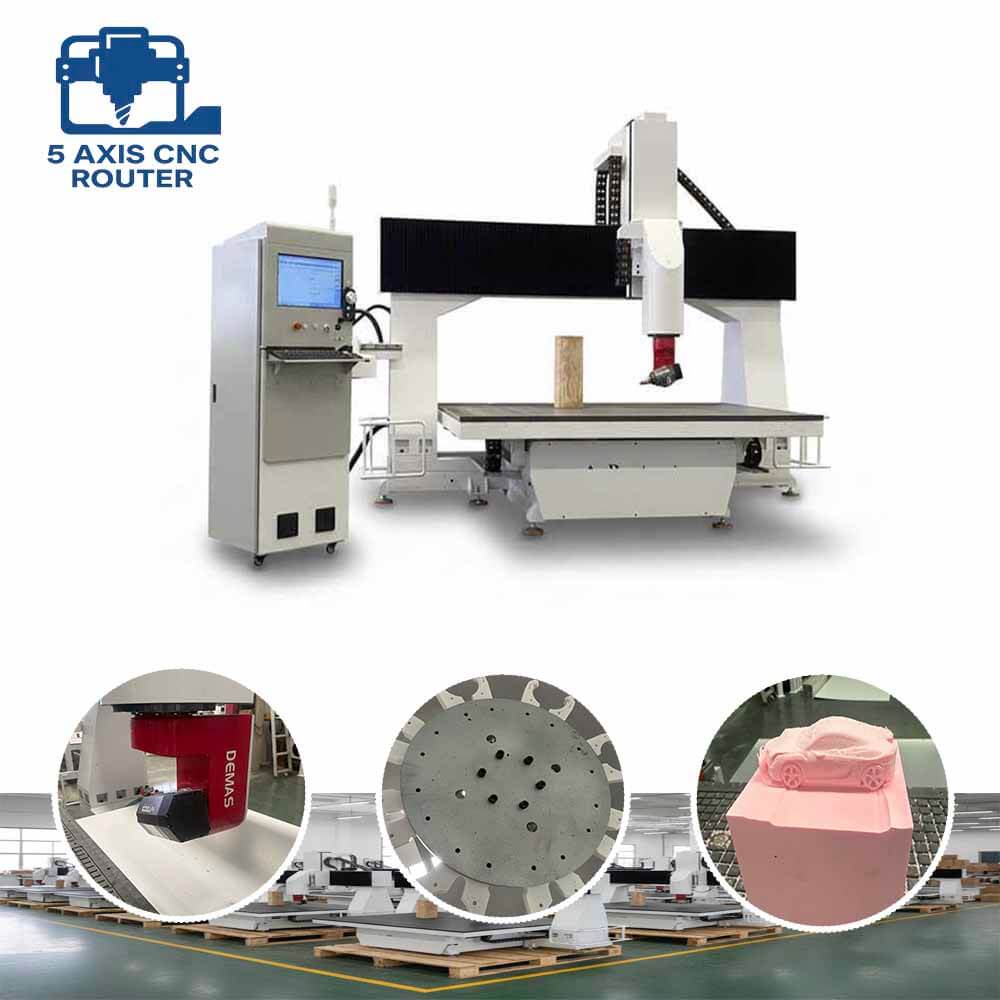
Top 5 Materials for 5 Axis CNC Routers and How to Maximize Production Efficiency
The versatility of 5 Axis CNC routers lies in their ability to work with a wide variety of materials, from soft woods to high-density composites. Choosing the right material is crucial for maximizing machine performance, ensuring precision, and improving overall production efficiency.
In this blog, we’ll cover the top 5 materials for 5 Axis CNC routers, explain their applications, and provide tips to optimize production while reducing waste and labor costs. Whether you’re producing furniture, molds, or composite parts, understanding material characteristics will help you get the most out of your CNC investment.
Table of Contents
Solid Wood
Solid wood is a staple in furniture manufacturing. Its natural beauty and durability make it ideal for premium products.
Why It Works Well with 5 Axis CNC Routers:
- Can be cut, carved, and shaped into complex designs with precision.
- Excellent for creating furniture, decorative panels, and custom carvings.
- Smooth finish achievable with minimal sanding when programmed correctly.
Tips to Maximize Efficiency:
- Use sharp, high-quality end mills designed for hardwood.
- Pre-plan grain direction to reduce tear-out and splintering.
- Program optimized cutting paths to minimize material waste.
MDF (Medium-Density Fiberboard)
MDF is widely used in cabinetry and furniture due to its affordability and uniformity.
Advantages:
- Smooth surface ideal for painting and veneering.
- Consistent density reduces cutting errors.
- Low cost allows experimentation with complex designs.
Efficiency Tips:
- Use carbide tools to reduce wear from MDF dust.
- Employ vacuum fixtures to hold panels securely during multi-axis cuts.
- Optimize feed rates to avoid burning edges.
Plywood
Plywood is a versatile engineered wood that combines multiple layers for strength and stability.
Why It’s Popular:
- Great for structural components in furniture.
- Resists warping better than solid wood.
- Can be cut into precise components for cabinets, chairs, and tables.
Efficiency Tips:
- Minimize tear-out by using climb cutting techniques.
- Plan nesting layouts in CAD/CAM software to reduce scrap.
- Match router bits to the plywood grade to prevent delamination.
Composites (Carbon Fiber, Fiberglass)
Composites are increasingly used in aerospace, automotive, and high-end furniture for their strength-to-weight ratio.
Advantages of Using 5 Axis CNC Routers:
- Ability to cut complex 3D shapes without multiple setups.
- High precision ensures tight tolerances for functional components.
- Reduces manual labor and improves repeatability.
Efficiency Tips:
- Use diamond-coated or carbide tools for longevity.
- Always wear protective gear due to fine composite dust.
- Optimize spindle speed and feed rates to prevent delamination or heat damage.
Plastics (Acrylic, PVC, HDPE)
Plastics are common in signage, furniture accents, and prototype components.
Benefits for CNC Routing:
- Easy to machine with low tool wear.
- Can achieve smooth edges for aesthetic applications.
- Lightweight and cost-effective for prototyping and batch production.
Efficiency Tips:
- Use sharp single-flute end mills to avoid melting.
- Maintain proper cooling and chip removal to preserve surface quality.
- Nest parts efficiently to maximize material usage.
Optimizing Production with Multi-Material Capability
Using a 5 Axis CNC router with multiple materials requires planning to maximize efficiency:
- Material Selection: Choose materials based on application, cost, and machine capability.
- Tool Management: Use dedicated tools for specific materials to reduce wear and ensure consistent quality.
- Software Optimization: CAD/CAM software can simulate cutting paths, optimize feed rates, and minimize tool changes.
- Fixture Setup: Use modular or vacuum fixtures to switch between materials quickly without compromising accuracy.
- Maintenance: Clean the machine and check spindle integrity regularly to maintain precision across materials.
Real-World Applications
- Furniture Manufacturers: Can switch between hardwood, MDF, and plywood for custom orders.
- Signage Industry: Acrylic and PVC are cut precisely for letters, logos, and panels.
- Aerospace & Automotive: Carbon fiber and fiberglass components are machined with high precision and minimal material waste.
Case Study: A furniture factory using a 5 Axis CNC router for mixed-material production reduced setup time by 35% and material waste by 25%, achieving faster delivery for custom orders.
Conclusion
Selecting the right material is just as important as choosing the right CNC router. By understanding the properties of solid wood, MDF, plywood, composites, and plastics, manufacturers can optimize production efficiency, reduce costs, and produce high-quality, precision parts consistently.
Integrating multi-material production with a 5 Axis CNC router allows workshops to stay competitive, meet diverse client demands, and maintain high standards of quality and precision.
Products Categories
Recently News


Why Choose Us
1.Experienced CNC manufacturer.
2.Strong R&D and innovation.
3.High-quality machine components.
4.Custom solutions available.
5.Strict quality control.
6.Fast production and delivery.
7.Professional technical support.
8.Competitive factory pricing.
9.Trusted by global customers.
10.One-stop CNC solutions.
Contact Us
- Wechat: ExtraCNC
- Whatsapp/Moblie:0086 15562628072
- Email: [email protected]
 EN
EN  AR
AR  EO
EO  IT
IT  DE
DE  KO
KO  JA
JA  RU
RU  AZ
AZ  BG
BG  CS
CS  DA
DA  EL
EL  ES
ES  FR
FR  ID
ID  LV
LV  NL
NL  ML
ML  PT
PT  TT
TT  SL
SL  TH
TH  UZ
UZ  UK
UK  SV
SV  TR
TR