
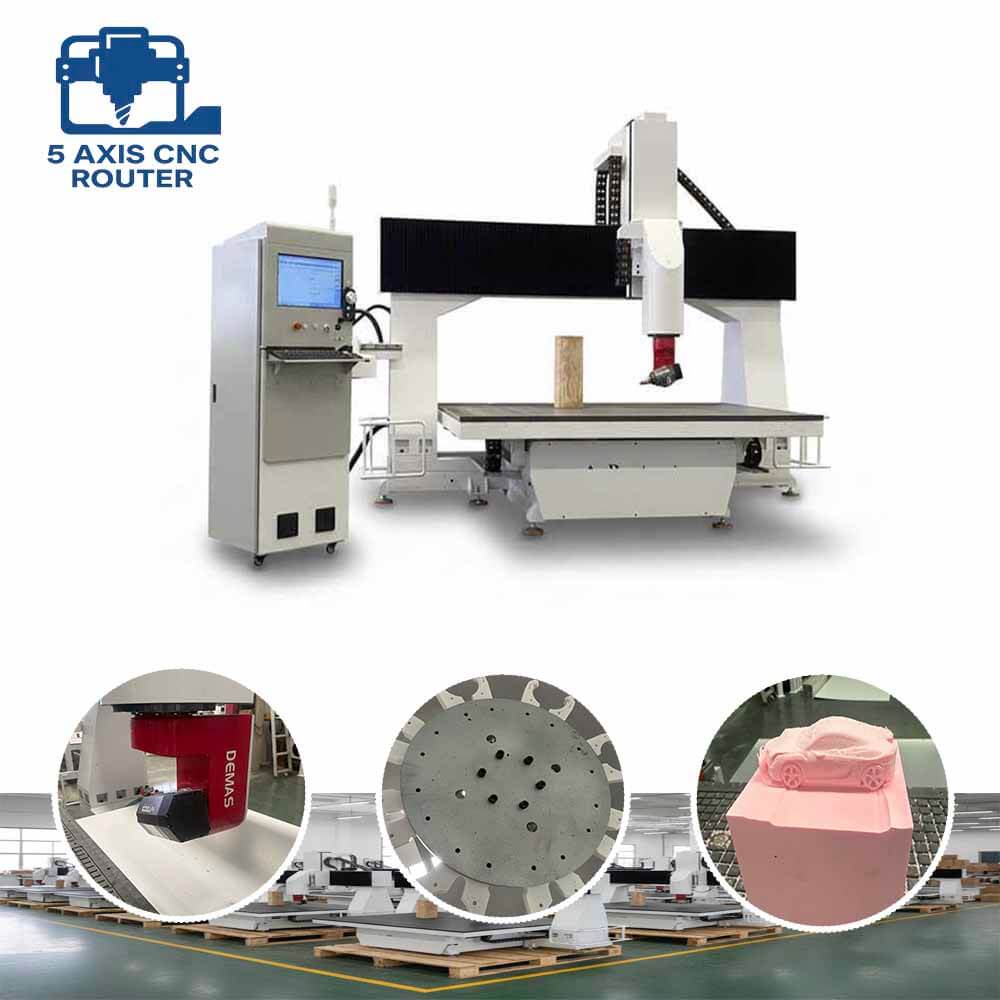
Is a 5 Axis CNC Router Worth It for Woodworking and Furniture Manufacturing?
For woodworking shops and furniture manufacturers, productivity, accuracy, and flexibility are critical. As product designs become more complex and customer expectations increase, many businesses start asking an important question:
Is a 5 axis CNC router really worth it for woodworking?
While traditional 3-axis CNC routers are still widely used, 5 axis CNC technology is gaining popularity in the woodworking and furniture industry. However, the higher investment cost raises valid concerns.
In this guide, we will explore whether a 5 axis CNC router is a smart investment for woodworking, what advantages it offers, which applications truly benefit from 5-axis machining, and how to choose the right configuration.
Table of Contents
Common Challenges in Woodworking and Furniture Manufacturing
Woodworking production faces several ongoing challenges:
- Complex curved and 3D designs
- Multiple setups for angled features
- Manual finishing and sanding
- Limited flexibility with traditional CNC routers
- Rising labor costs
As design complexity increases, the limitations of standard 3-axis machines become more noticeable.
What a 5 Axis CNC Router Can Do for Woodworking
A 5 axis CNC router adds two rotary axes to the traditional three linear axes, allowing the cutting tool to approach the workpiece from multiple angles.
Key Capabilities for Wood Applications
- Machining complex 3D shapes
- Cutting angled holes and surfaces
- Reducing multiple setups
- Improving surface finish
- Increasing production efficiency
For woodworking applications, this flexibility can result in significant time and cost savings.
Typical Woodworking Applications for a 5 Axis CNC Router
A 5 axis CNC router is especially valuable for the following woodworking tasks:
1. Curved Furniture Components
Chair legs, table bases, and curved panels can be machined accurately without repositioning the workpiece.
2. Custom Furniture and Solid Wood Parts
High-end custom furniture often requires complex shapes that are difficult to produce with 3-axis machines.
3. Staircase and Architectural Elements
Spirals, handrails, and decorative components benefit greatly from multi-axis machining.
4. Pattern and Prototype Making
Rapid prototyping becomes faster and more precise with fewer setups.
3 Axis vs 5 Axis CNC Router for Woodworking
Setup Time Reduction
A 5 axis CNC router can complete complex parts in one setup, while a 3-axis machine may require multiple repositioning steps.
Improved Surface Quality
Continuous tool orientation improves cutting angles, resulting in smoother surfaces and less manual finishing.
Production Efficiency
Although cycle times may be longer for complex toolpaths, overall production throughput often improves due to reduced setup and handling time.
Do You Really Need a True 5 Axis CNC Router for Wood?
For most woodworking and furniture applications, the answer is not always.
3+2 Axis CNC Router for Woodworking
A 3+2 axis CNC router allows the spindle to tilt to a fixed angle, which is often sufficient for:
- Wood furniture parts
- Mold patterns
- Foam and wood models
This configuration offers many benefits of 5 axis machining at a lower cost.
True 5 Axis CNC Router
A true 5 axis CNC router is recommended when:
- Parts include complex free-form surfaces
- Continuous tool orientation is required
- High-end artistic or architectural projects are involved
Cost vs Value: Is It Worth the Investment?
The cost of a 5 axis CNC router for woodworking typically ranges from:
USD 40,000 – 70,000 for 3+2 axis systems
USD 70,000 – 120,000+ for true 5 axis machines
Whether it is worth the investment depends on:
- Production volume
- Part complexity
- Labor savings
- Market positioning
- For many furniture manufacturers, the improved flexibility and reduced labor costs justify the higher initial expense.
ROI Analysis for Woodworking Shops
Most woodworking shops see ROI through:
- Reduced setup time
- Lower labor dependency
- Improved repeatability
- Ability to accept more complex orders
In many cases, businesses recover their investment within 2–3 years, especially when producing high-value customized furniture.
How to Decide If a 5 Axis CNC Router Is Right for You
Ask yourself:
- Are my designs becoming more complex?
- Do I need to reduce manual finishing?
- Can I produce higher-value products with better accuracy?
- Do I want to expand into premium custom furniture?
If the answer is “yes,” a 5 axis CNC router may be a valuable upgrade.
Manufacturer Recommendation: Start with the Right Configuration
From a manufacturer’s perspective, many woodworking customers achieve the best results with a well-configured 3+2 axis CNC router. It balances performance, cost, and ease of use.
A true 5 axis CNC router should be considered when production demands clearly justify its advanced capabilities.
Final Verdict: Is a 5 Axis CNC Router Worth It for Woodworking?
Yes, if you:
- Produce complex and high-value wood products
- Want to reduce manual operations
- Aim to stay competitive in custom furniture markets
Not always, if:
- Your products are primarily flat or simple shapes
- Production volume does not justify the investment
Get Expert Advice for Your Woodworking Application
Choosing the right CNC router is a strategic decision. Consulting with an experienced manufacturer helps ensure the machine fits your real production needs.
Contact us today for professional advice and a customized 5 axis CNC router solution for woodworking and furniture manufacturing.
Products Categories
Recently News


Why Choose Us
1.Experienced CNC manufacturer.
2.Strong R&D and innovation.
3.High-quality machine components.
4.Custom solutions available.
5.Strict quality control.
6.Fast production and delivery.
7.Professional technical support.
8.Competitive factory pricing.
9.Trusted by global customers.
10.One-stop CNC solutions.
Contact Us
- Wechat: ExtraCNC
- Whatsapp/Moblie:0086 15562628072
- Email: [email protected]
 EN
EN  AR
AR  EO
EO  IT
IT  DE
DE  KO
KO  JA
JA  RU
RU  AZ
AZ  BG
BG  CS
CS  DA
DA  EL
EL  ES
ES  FR
FR  ID
ID  LV
LV  NL
NL  ML
ML  PT
PT  TT
TT  SL
SL  TH
TH  UZ
UZ  UK
UK  SV
SV  TR
TR