
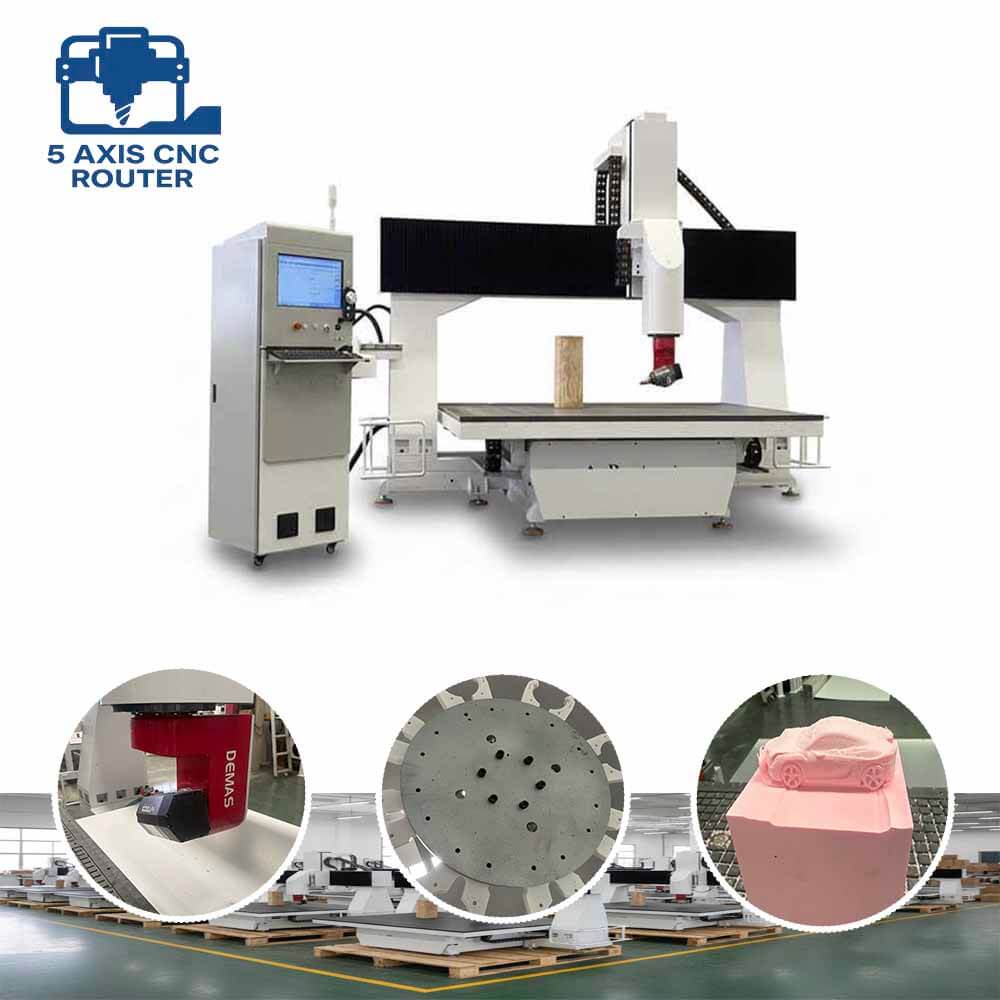
Disadvantages of 5 Axis CNC Routers You Should Understand Before Buying
5 axis CNC routers are often presented as the ultimate solution for complex machining, but in real manufacturing environments they come with non‑trivial disadvantages. These limitations are rarely discussed openly, yet they play a decisive role in whether a 5 axis investment succeeds or fails.
This article examines the practical disadvantages of 5 axis CNC routers from an engineering, operational, and financial perspective. The goal is not to discourage adoption, but to help decision‑makers align expectations with reality.
Table of Contents
Higher System Complexity
The most fundamental drawback of a 5 axis CNC router is system complexity.
Compared to 3 axis machines, a 5 axis system introduces:
Two additional rotary axes
More complex kinematic chains
Tighter alignment and calibration requirements
Each additional axis increases the number of potential failure points. Problems that are easy to diagnose on a 3 axis machine often require deeper technical expertise on a 5 axis platform.
Practical implication:
Troubleshooting becomes a multidisciplinary task involving mechanics, control logic, and CAM data.
Increased Programming and CAM Demands
5 axis CNC routing shifts a significant portion of manufacturing risk into the CAM stage.
CAM Challenges Include:
Collision avoidance between tool, holder, and machine
Tool orientation strategy selection
Smooth axis interpolation
Accurate post‑processor configuration
Inadequate CAM output can lead to:
Axis over‑travel
Surface gouging
Excessive rotary motion
Reduced surface quality
This means the machine capability is only as strong as the CAM workflow supporting it.
Higher Operator Skill Requirements
Operating a 5 axis CNC router is not a simple extension of 3 axis experience.
Operators must understand:
Multi‑axis kinematics
Coordinate transformations
Tool center point (TCP) behavior
Machine limits in tilted configurations
Without proper training, the risk of:
Crashes
Scrap parts
Under‑utilization
increases significantly.
Reality check:
Many shops own 5 axis machines but continue to run them in 3+2 or even 3 axis mode due to skill gaps.
4. Greater Risk of Machine Collisions
Simultaneous five‑axis motion increases collision exposure.
Common collision scenarios include:
Tool holder contacting the workpiece
Rotary axes exceeding safe angles
Fixtures intersecting machine structures
Even minor collisions can:
Damage rotary bearings
Affect axis accuracy
Require recalibration
Unlike linear axes, rotary axis damage is often expensive and time‑consuming to repair.
5. Accuracy Is Harder to Maintain Over Time
While 5 axis machines can reduce setup‑related errors, they introduce kinematic accuracy challenges.
Accuracy depends on:
Rotary axis calibration
Thermal stability
Encoder resolution
Control compensation models
As components wear, maintaining consistent accuracy requires:
Regular calibration
Specialized measuring equipment
Skilled service support
This ongoing effort is frequently underestimated during purchasing decisions.
6. Higher Maintenance and Service Costs
A 5 axis CNC router typically has:
More bearings
More drives
More sensors
More complex control software
As a result:
Preventive maintenance schedules are longer
Spare parts are more expensive
Downtime impact is greater
Cost consideration:
Maintenance costs scale with system complexity, not just machine size.
7. Longer Setup and Validation Time
Before running production parts, 5 axis jobs often require:
Simulation
Dry runs
Incremental validation
This front‑loaded effort reduces flexibility for:
Short production runs
Rapid job changes
In contrast, simpler machines may reach stable production faster for basic parts.
8. Higher Initial Investment With Delayed ROI
The purchase price of a 5 axis CNC router is only part of the investment.
Additional costs include:
Advanced CAM software
Operator training
Post‑processor development
Calibration tools
ROI is often delayed until:
Skill levels increase
Processes stabilize
Machine utilization improves
For some businesses, this delay creates financial pressure.
When These Disadvantages Matter Most
The disadvantages outlined above are most significant when:
Part geometry does not require continuous 5 axis motion
Production volume is low
Skilled operators are unavailable
CAM support is limited
In these scenarios, simpler configurations may deliver better overall performance.
Frequently Asked Questions
Are 5 axis CNC routers harder to maintain than 3 axis machines?
Yes. Increased mechanical and control complexity leads to higher maintenance demands.
Do all shops benefit from 5 axis capability?
No. Shops producing simple or planar parts may see little advantage.
Is CAM software the biggest limitation?
In many cases, yes. CAM quality directly affects safety and surface results.
Can a 5 axis machine be safely run by a 3 axis operator?
Only after proper training. Skill gaps significantly increase risk.
Are crashes more common on 5 axis machines?
The risk is higher due to complex motion, especially without accurate simulation.
Conclusion
A 5 axis CNC router is a powerful tool, but it is not a universally superior solution.
Its disadvantages — complexity, cost, skill requirements, and maintenance demands — must be weighed against the actual geometric needs of the parts being produced.
A successful investment depends less on owning advanced technology and more on aligning machine capability with real production requirements.
Products Categories
Recently News


Why Choose Us
1.Experienced CNC manufacturer.
2.Strong R&D and innovation.
3.High-quality machine components.
4.Custom solutions available.
5.Strict quality control.
6.Fast production and delivery.
7.Professional technical support.
8.Competitive factory pricing.
9.Trusted by global customers.
10.One-stop CNC solutions.
Contact Us
- Wechat: ExtraCNC
- Whatsapp/Moblie:0086 15562628072
- Email: [email protected]
 EN
EN  AR
AR  EO
EO  IT
IT  DE
DE  KO
KO  JA
JA  RU
RU  AZ
AZ  BG
BG  CS
CS  DA
DA  EL
EL  ES
ES  FR
FR  ID
ID  LV
LV  NL
NL  ML
ML  PT
PT  TT
TT  SL
SL  TH
TH  UZ
UZ  UK
UK  SV
SV  TR
TR