
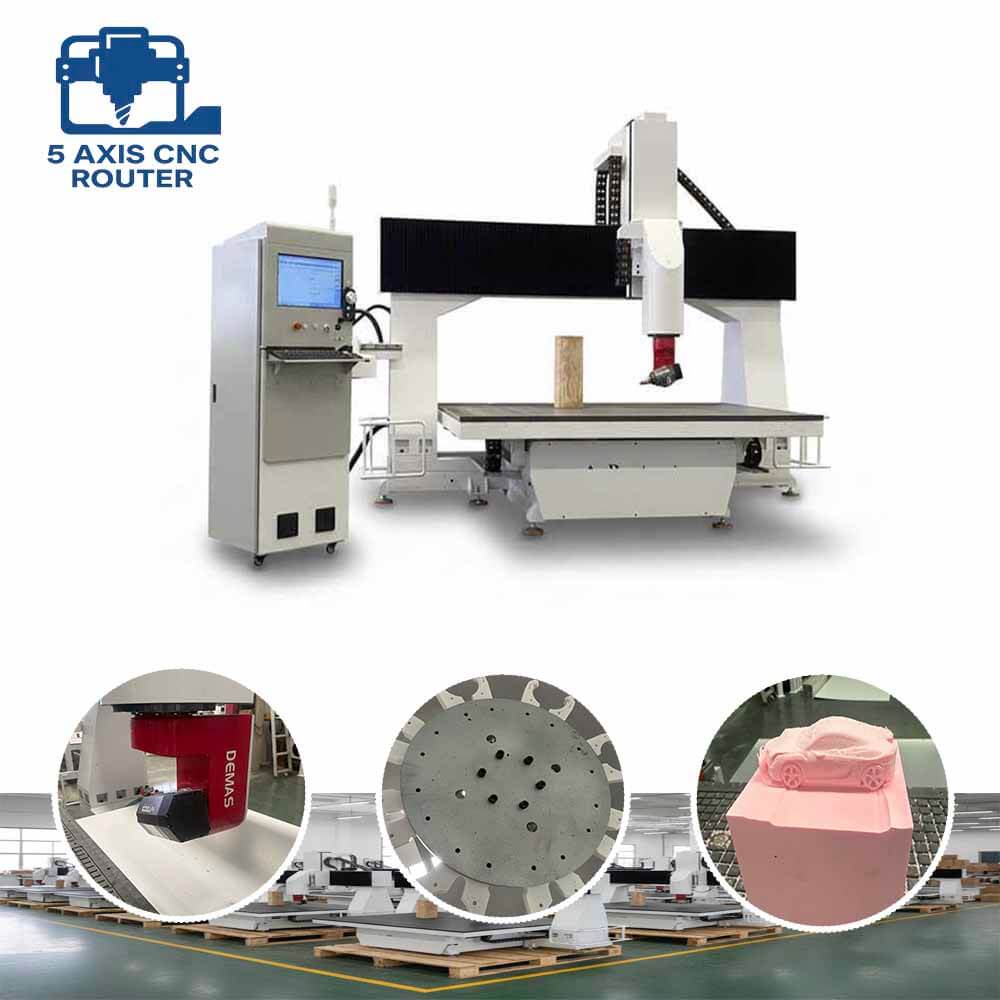
What Makes a “True” 5 Axis CNC Router?
The term “5 axis CNC router” is widely used, but not always accurately. In many cases, machines marketed as 5 axis systems are actually 3+2 axis configurations, which behave very differently in real production.
For buyers, this distinction is critical. The difference between a true 5 axis CNC router and a positional 3+2 system determines surface quality, programming complexity, achievable geometry, and overall return on investment.
This article explains what technically defines a true 5 axis CNC router, how it differs from 3+2 axis machines, and when the difference matters in practice.
Table of Contents
The Core Definition of True 5 Axis Machining
A CNC machine is considered true 5 axis when:
All five axes can move simultaneously and continuously during cutting.
This means:
Linear axes (X, Y, Z) interpolate in real time
Two rotary axes (A/B/C depending on design) move at the same time
Tool orientation changes continuously along the toolpath
If any rotary axis must stop and lock before cutting resumes, the machine is not operating as a true 5 axis system during that operation.
3+2 Axis vs True 5 Axis: The Practical Difference
How 3+2 Axis Systems Work
In a 3+2 axis configuration:
Two rotary axes position the part or tool
The machine locks those axes
Machining proceeds using only X, Y, Z
This allows angled machining, but tool orientation remains fixed during cutting.
What Changes with True 5 Axis
In a true 5 axis CNC router:
Tool orientation adapts continuously to surface geometry
The cutter remains normal (or optimized) to the surface
Undercuts and compound curves become machinable
Why Continuous Tool Orientation Matters
Continuous tool orientation directly affects:
1. Surface Quality
Maintaining the correct tool angle:
Reduces scalloping
Improves surface consistency
Minimizes secondary finishing
2. Tool Life
Shorter tools and optimized contact angles:
Reduce bending forces
Lower vibration
Extend tool life
3. Geometric Capability
True 5 axis motion enables:
Deep cavities with angled walls
Compound freeform surfaces
Smooth transitions between faces
These geometries are either inefficient or impossible with indexed machining.
Mechanical Design Requirements for True 5 Axis
Not all machines labeled “5 axis” are mechanically capable of stable simultaneous motion.
Structural Rigidity
True 5 axis routing introduces complex force vectors. The machine must maintain stiffness across:
Tilting heads
Rotary tables
Extended tool reach
Weak structures amplify vibration during multi-axis motion.
Rotary Axis Precision
Critical factors include:
Low backlash
High-resolution encoders
Stable bearings
Accurate axis alignment
Even small rotary errors are magnified at the tool tip.
Control System and Kinematic Modeling
True 5 axis machining depends heavily on the CNC control.
The controller must:
Perform real-time kinematic transformations
Compensate for axis offsets
Synchronize five-axis motion accurately
An inaccurate kinematic model leads to:
Surface distortion
Inconsistent tool orientation
Dimensional errors
This is why control quality matters as much as mechanical design.
CAM Software: A Hidden Limitation
Even with capable hardware, true 5 axis machining fails without proper CAM support.
CAM software must handle:
Collision avoidance
Tool orientation strategies
Smooth axis interpolation
Post-processor accuracy
Inadequate CAM often forces users to fall back to indexed machining, negating the benefits of a true 5 axis system.
When a True 5 Axis CNC Router Is Necessary
A true 5 axis CNC router is justified when:
Parts have continuously changing surface normals
Undercuts are unavoidable
Surface finish quality is critical
Multi-face machining in one setup is required
Examples include:
Mold and pattern making
Aerospace interior components
Complex composite parts
Sculptural or freeform designs
When 3+2 Axis Is Enough
A true 5 axis system may be unnecessary if:
Features are planar but angled
Tool orientation changes are infrequent
Surface quality requirements are moderate
In these cases, 3+2 axis machining provides most of the benefit at lower cost and complexity.
Common Misconceptions About True 5 Axis Machines
“True 5 axis is always faster” — Not necessarily; toolpaths are often longer.
“It guarantees better accuracy” — Accuracy depends on calibration and kinematics.
“Any CAM can handle it” — CAM capability varies widely.
“Operators don’t matter” — Skill requirements increase significantly.
Understanding these realities avoids misaligned expectations.
Frequently Asked Questions
Is a true 5 axis CNC router better than 3+2 axis?
Only when continuous tool orientation is required during cutting.
Can a 3+2 axis machine be upgraded to true 5 axis?
Usually not, due to mechanical and control limitations.
Does true 5 axis reduce setup time?
Yes, when parts can be completed in a single setup.
Is true 5 axis harder to program?
Yes. CAM programming complexity increases significantly.
Do all industries need true 5 axis routing?
No. Many applications are fully served by 3 or 3+2 axis machines
Conclusion
A true 5 axis CNC router is defined not by how many axes it has, but by how those axes move together during cutting.
The value of true 5 axis machining lies in continuous tool orientation, reduced setups, and improved surface control — not in marketing labels.
Before choosing a machine, the most important question is:
Does my part geometry require continuous five-axis motion, or only positional access?
The answer determines whether true 5 axis capability is a necessity or an unnecessary complexity.
Products Categories
Recently News


Why Choose Us
1.Experienced CNC manufacturer.
2.Strong R&D and innovation.
3.High-quality machine components.
4.Custom solutions available.
5.Strict quality control.
6.Fast production and delivery.
7.Professional technical support.
8.Competitive factory pricing.
9.Trusted by global customers.
10.One-stop CNC solutions.
Contact Us
- Wechat: ExtraCNC
- Whatsapp/Moblie:0086 15562628072
- Email: [email protected]
 EN
EN  AR
AR  EO
EO  IT
IT  DE
DE  KO
KO  JA
JA  RU
RU  AZ
AZ  BG
BG  CS
CS  DA
DA  EL
EL  ES
ES  FR
FR  ID
ID  LV
LV  NL
NL  ML
ML  PT
PT  TT
TT  SL
SL  TH
TH  UZ
UZ  UK
UK  SV
SV  TR
TR