
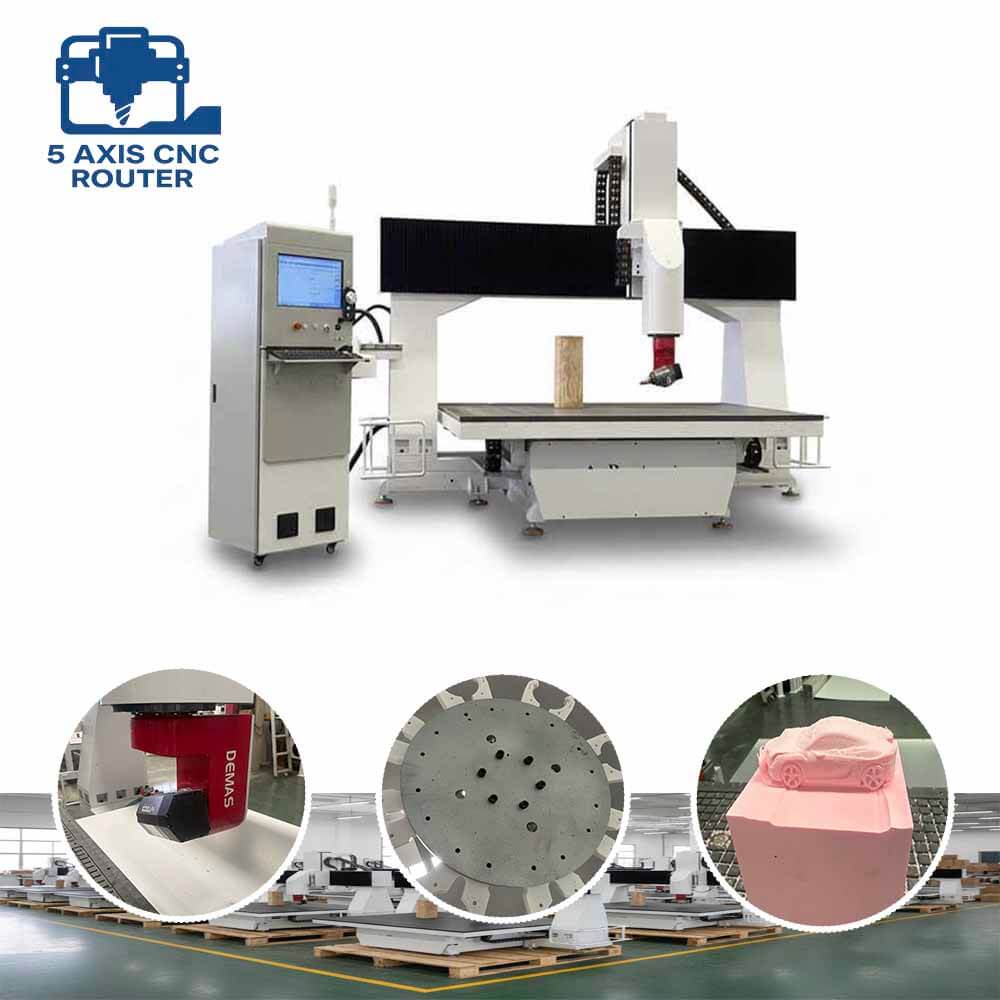
5 Axis CNC Router Accuracy Explained: What Really Determines Precision in Real Production
Why “Accuracy” Is the Most Misunderstood Part of 5 Axis CNC Routers
Many buyers believe that accuracy is a single number:
±0.01 mm
In 5 axis CNC machining, this assumption is fundamentally wrong.
Accuracy in a 5 axis CNC router is not one value—it is the combined result of linear axes, rotary axes, kinematic calibration, structural stiffness, and control algorithms.
This article breaks down:
What accuracy actually means in 5 axis machining
Which accuracy metrics matter
Why some machines “meet specs” but fail in production
Table of Contents
1. Positioning Accuracy vs Machining Accuracy
Positioning Accuracy
This refers to:
How precisely an axis moves to a commanded position
Usually measured with laser interferometers
Machining Accuracy
This reflects:
Tool position under load
Combined error during cutting
Thermal and dynamic effects
Engineering Reality
A machine can have excellent positioning accuracy and still produce inaccurate parts.
Machining accuracy is always lower than positioning accuracy—and that gap matters.
Why Rotary Axes Change Everything
In a 3 axis machine:
Errors are mostly linear and additive
In a 5 axis machine:
Rotary axis errors multiply spatially
Common Rotary Axis Error Sources
Axis center offset
Angular backlash
Tilt-axis repeatability
Encoder resolution limits
Critical Insight
A 0.01° angular error can translate into tenths of a millimeter at the tool tip—depending on tool length.
This is why rotary accuracy is more important than linear accuracy in many 5 axis applications.
Tool Length Amplification Effect
The Longer the Tool, the Larger the Error
In 5 axis routing:
Spindles tilt
Tool length increases the error lever arm
Example
Tool length: 200 mm
Rotary tilt error: 0.02°
Result:
Tool tip deviation ≈ 0.07 mm
This effect is invisible in brochures—but critical in molds and complex surfaces.
4. RTCP: The Core of 5 Axis Accuracy
RTCP (Rotational Tool Center Point) ensures:
Tool tip remains fixed while axes rotate
Without Proper RTCP
CAM paths become inaccurate
Surface transitions show steps
Dimensional drift occurs
Engineering Note
RTCP accuracy depends on calibration quality, not just controller capability.
A controller may support RTCP, but:
Poor calibration = poor results
5. Kinematic Calibration: The Hidden Foundation
What Is Kinematic Calibration?
It defines:
Exact spatial relationships between axes
Rotary center positions
Axis orthogonality
Common Calibration Methods
Ballbar testing
Laser tracking
Touch probe routines
Why It Matters
Kinematic errors compound across multiple axes.
Without regular calibration:
Accuracy degrades over time
Repeatability drops
6. Structural Rigidity and Accuracy Under Load
Accuracy is meaningless if:
The frame flexes during cutting
The head assembly deflects
Key Structural Contributors
Gantry stiffness
Head mounting interface
Rotary axis bearing preload
Important Reality
Structural deflection cannot be compensated by software.
Once the machine bends, accuracy is lost.
7. Thermal Effects in Long 5 Axis Jobs
Heat Sources
Spindle motor
Servo motors
Ambient temperature variation
Typical Symptoms
Drift during long cycles
Dimensional inconsistency between parts
Industrial Mitigation
Symmetrical machine design
Controlled warm-up routines
Temperature compensation tables
8. Repeatability vs Absolute Accuracy
Repeatability
Ability to return to the same position
Often more important in production
Absolute Accuracy
Closeness to nominal dimension
Production Insight
High repeatability with controlled offsets is often preferable to unstable absolute accuracy.
Many successful shops prioritize repeatability.
9. How to Evaluate Accuracy Before Buying
Ask for These, Not Brochures
Ballbar test reports
Rotary axis repeatability data
RTCP calibration method
Red Flags
Only linear axis specs provided
No rotary error data
No explanation of test standards
Frequently Asked Questions
1. Why does 5 axis accuracy vary more than 3 axis?
Because rotary axis errors amplify spatially at the tool tip.
2. Is RTCP mandatory for 5 axis machining?
Yes. Without RTCP, true 5 axis accuracy is not achievable.
3. How often should kinematic calibration be done?
Typically every 6–12 months, depending on usage.
4. Can software fully compensate mechanical errors?
Only partially. Structural and dynamic errors cannot be eliminated digitally.
5. Is higher price always more accurate?
No. Calibration quality and structure matter more than price alone.
6. What accuracy should I realistically expect?
That depends on material, tool length, and cutting conditions—not marketing specs.
Conclusion
A 5 axis CNC router’s accuracy depends on:
Mechanical design
Calibration discipline
Process understanding
There is no single spec that guarantees precision.
The most accurate 5 axis machines are those that are well-calibrated, structurally rigid, and used within their engineering limits.
Products Categories
Recently News


Why Choose Us
1.Experienced CNC manufacturer.
2.Strong R&D and innovation.
3.High-quality machine components.
4.Custom solutions available.
5.Strict quality control.
6.Fast production and delivery.
7.Professional technical support.
8.Competitive factory pricing.
9.Trusted by global customers.
10.One-stop CNC solutions.
Contact Us
- Wechat: ExtraCNC
- Whatsapp/Moblie:0086 15562628072
- Email: [email protected]
 EN
EN  AR
AR  EO
EO  IT
IT  DE
DE  KO
KO  JA
JA  RU
RU  AZ
AZ  BG
BG  CS
CS  DA
DA  EL
EL  ES
ES  FR
FR  ID
ID  LV
LV  NL
NL  ML
ML  PT
PT  TT
TT  SL
SL  TH
TH  UZ
UZ  UK
UK  SV
SV  TR
TR