
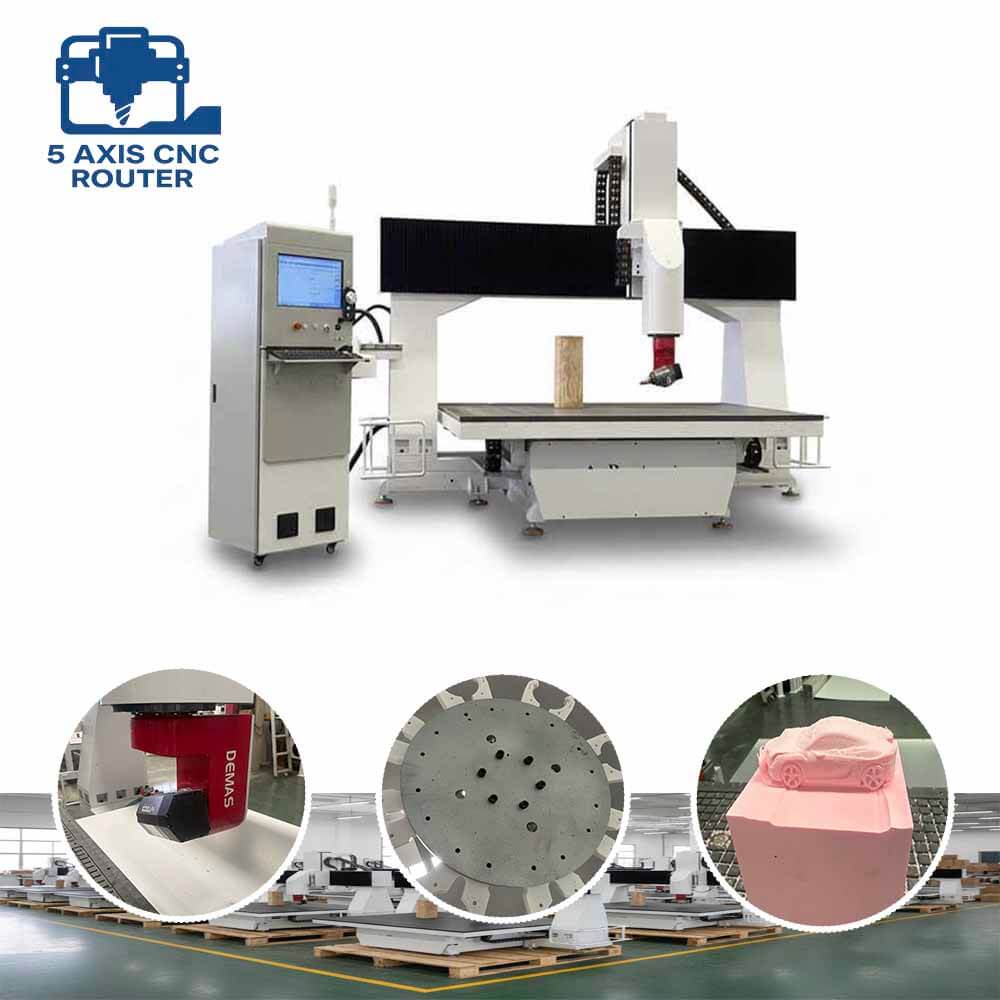
How 5 Axis CNC Routers Enhance Precision in Aerospace and Automotive Components
In aerospace and automotive industries, precision is non-negotiable. Complex parts with curved surfaces, undercuts, and multi-plane features demand tight tolerances and repeatable accuracy.
Traditional 3 axis routers or 3+2 machining often fall short, requiring multiple setups and secondary finishing.
5 axis CNC routers enable simultaneous multi-axis machining, maintaining precise tool orientation across complex geometries. This article explores how 5 axis CNC routers improve precision, the factors affecting accuracy, and practical strategies for ensuring high-quality outcomes.
Table of Contents
The Precision Advantage of Multi-Axis Machining
Continuous Tool Orientation
Simultaneous 5 axis movement allows:
Tool to remain normal to the cutting surface
Constant contact across complex curves
Minimized step marks and surface irregularities
This continuous orientation reduces errors associated with:
Repositioning between setups
Fixturing misalignment
Tool deflection under variable cutting forces
Volumetric Accuracy vs Linear Accuracy
Linear accuracy measures movement along individual axes
Volumetric accuracy accounts for cumulative errors across X, Y, Z, A, and C axes
Volumetric accuracy is the key metric for aerospace and automotive parts, ensuring that all surfaces align precisely in 3D space.
Factors Affecting Precision
Machine Structure and Rigidity
Rigid gantry and linear guide design reduce deflection
Welded or cast structures minimize vibration
Proper stress-relief and thermal stabilization enhance repeatability
Rotary Axis Performance
Encoder resolution and backlash compensation affect surface accuracy
Torque stability prevents rotational deviation under cutting forces
Misalignment in A or C axes can cause cumulative errors in complex surfaces
Spindle and Tooling Considerations
Low runout spindles improve dimensional precision
Tool selection and sharpness directly affect surface finish
Proper tool holding (HSK, BT, ISO) maintains repeatable positioning
Thermal Stability
Extended machining cycles generate heat
Thermal expansion affects tool and part position
Cooling strategies and machine material selection mitigate dimensional drift
Aerospace Component Applications
Composite Tooling and Prototypes
Carbon fiber molds require precise surface conformity
Multi-face features are machined in a single setup to reduce alignment errors
High feed rates with proper tool orientation prevent delamination
Aluminum Components
Light structural parts, brackets, and housings benefit from single-setup machining
Torque-controlled spindle and feed optimization maintain surface integrity
Reduces need for secondary machining or manual finishing
Automotive Component Applications
Sculpted Panels and Ergonomic Surfaces
Dashboard, interior trim, and body prototypes often feature complex curves
5 axis routers maintain dimensional consistency across faces
Eliminates cumulative error from multiple setups
Small-Batch Production
Prototyping and limited runs benefit from accurate machining without expensive dedicated tooling
Reduces scrap and rework associated with 3 axis machining
Process Optimization for Maximum Precision
CAM Programming
Generate toolpaths considering multi-axis kinematics
Optimize entry, exit, and feed rates for continuous engagement
Validate collision detection and rotational limits
Fixturing and Workholding
Minimal re-clamping to preserve reference coordinates
Ensure stability for long or heavy components
Modular fixtures allow consistent positioning for repetitive tasks
Toolpath Verification and Simulation
Simulate multi-axis movements to identify potential deviations
Analyze volumetric error projections
Adjust tool orientation or sequence to improve surface accuracy
Material-Specific Precision Considerations
| Material | Key Precision Factors | Recommended Practices |
|---|---|---|
| Aluminum | Thermal expansion | Use coolant, control spindle speed |
| Composites | Layer delamination | Maintain proper cutting angle, use diamond-coated tools |
| Plastics | Surface melt and warping | Adjust feed and spindle speed |
| Wood | Grain tear-out | Orient cuts along fiber, sharp tooling |
| MDF | Minimal variation | Optimize toolpaths for continuous engagement |
Limitations and Boundary Conditions
Extremely large parts may exceed volumetric accuracy limits due to axis deflection
High-speed cuts on dense or abrasive materials require careful torque and tool selection
Operator skill is critical in programming and verifying multi-axis toolpaths
Maintenance and calibration are essential for long-term precision
Frequently Asked Questions
How precise are 5 axis CNC routers compared to 3 axis machines?
5 axis machines can achieve higher precision on complex multi-face parts due to single-setup machining and continuous tool orientation.
What affects volumetric accuracy the most?
Machine rigidity, rotary axis performance, thermal stability, and tool holding all play major roles.
Can 5 axis routers handle aerospace-grade materials?
Yes, with proper tooling, spindle speed, and feed rates for aluminum, composites, and light alloys.
Do 5 axis routers eliminate the need for finishing?
Not always. Some applications may require minimal finishing, but step marks and misalignment are greatly reduced.
How critical is CAM software for precision?
Extremely critical. Toolpaths, feed rates, and rotational angles must be accurately programmed to achieve the desired tolerances.
Is operator skill a limiting factor?
Yes. Knowledge of multi-axis kinematics, material behavior, and machine calibration is essential for precision.
Conclusion
5 axis CNC routers significantly enhance precision in aerospace and automotive components by maintaining continuous tool orientation, reducing setup errors, and optimizing multi-axis toolpaths. When combined with proper fixturing, CAM programming, and machine maintenance, these routers allow manufacturers to achieve tight tolerances, consistent surface quality, and repeatable accuracy.
Understanding limitations, material-specific factors, and operator requirements ensures that precision benefits are realized consistently in industrial production.
Products Categories
Recently News


Why Choose Us
1.Experienced CNC manufacturer.
2.Strong R&D and innovation.
3.High-quality machine components.
4.Custom solutions available.
5.Strict quality control.
6.Fast production and delivery.
7.Professional technical support.
8.Competitive factory pricing.
9.Trusted by global customers.
10.One-stop CNC solutions.
Contact Us
- Wechat: ExtraCNC
- Whatsapp/Moblie:0086 15562628072
- Email: [email protected]
 EN
EN  AR
AR  EO
EO  IT
IT  DE
DE  KO
KO  JA
JA  RU
RU  AZ
AZ  BG
BG  CS
CS  DA
DA  EL
EL  ES
ES  FR
FR  ID
ID  LV
LV  NL
NL  ML
ML  PT
PT  TT
TT  SL
SL  TH
TH  UZ
UZ  UK
UK  SV
SV  TR
TR