How 5 Axis CNC Routers Improve Efficiency in Furniture Manufacturing
In modern furniture manufacturing, precision, repeatability, and surface quality are essential. Complex designs with curved components, sculpted panels, and intricate joinery often exceed the capabilities of standard 3 axis CNC routers.
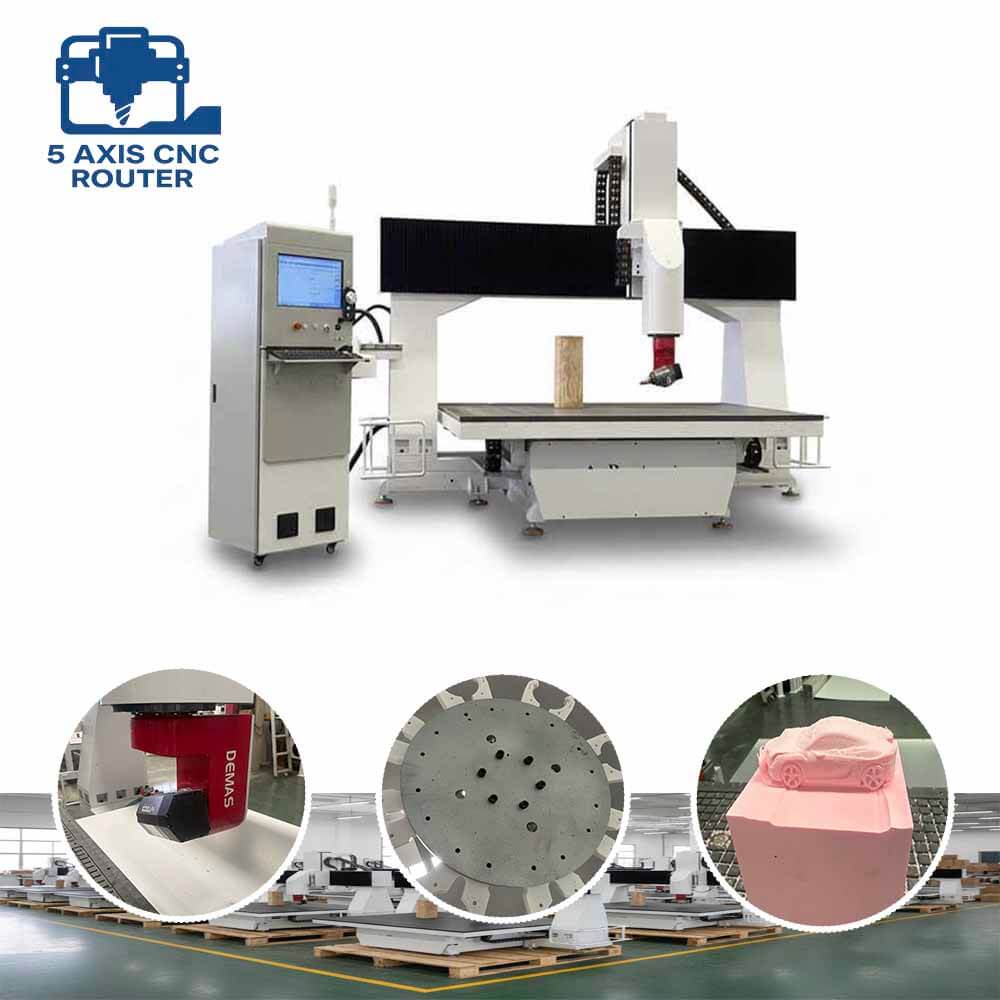
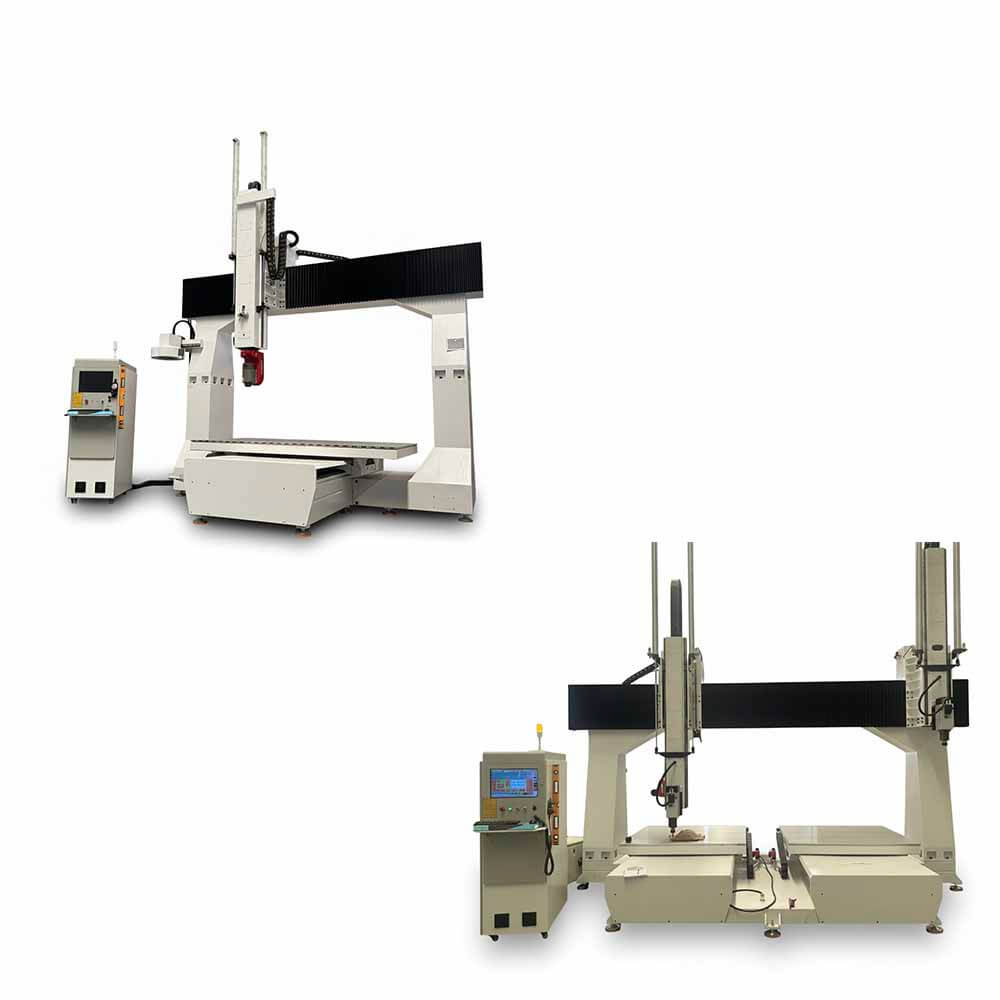
A 5 axis CNC router allows simultaneous movement of the cutting tool along three linear axes and two rotational axes, enabling multi-directional machining in a single setup. This article analyzes how 5 axis CNC routers improve efficiency in furniture production, identifies real-world limitations, and provides guidance for process optimization.
Table of Contents
Understanding 5 Axis Machining in Furniture Manufacturing
Multi-Axis Motion Advantages
Standard 3 axis routers are limited to vertical or horizontal cutting along the X, Y, and Z axes. Multiple setups are often required for complex surfaces, leading to:
Increased labor time
Setup errors
Surface imperfections
A 5 axis router reduces or eliminates these constraints by allowing:
Tilted tool orientation
Simultaneous cutting along multiple planes
Continuous machining without re-clamping
Tool Accessibility for Sculpted Components
Furniture components such as chair backs, table legs, and decorative panels often include curves, undercuts, or free-form surfaces. True 5 axis routing provides:
Access to difficult-to-reach surfaces
Optimized cutting angles for smooth finishes
Reduction in secondary finishing processes
This capability is particularly important for high-end custom furniture and architectural woodworking.
Workflow Efficiency Improvements
Reduced Setups
In traditional 3 axis machining:
Multi-sided components require multiple re-clamping
Each setup introduces alignment errors and increases cycle time
5 axis CNC routers allow machining of multiple faces in a single setup. Benefits include:
Reduced labor and operator intervention
Lower risk of dimensional inconsistencies
Shorter lead times for complex components
Shorter Machining Time
Simultaneous multi-axis interpolation reduces total machining time by:
Eliminating repositioning delays
Maintaining continuous tool engagement
Reducing toolpath segmentation
In high-mix or small-batch production, this effect is amplified.
Material Utilization and Waste Reduction
Accurate multi-axis routing:
Minimizes overcuts and errors
Reduces scrap rates
Optimizes nesting strategies for decorative panels
Improved precision translates directly into material cost savings over large production runs.
Surface Finish and Quality Control
Maintaining Optimal Cutting Angles
Proper tool orientation reduces:
Scalloping on curved surfaces
Tool marks
Surface roughness
High-quality surface finishes reduce sanding and finishing requirements, which are labor-intensive in furniture production.
Repeatability Across Batches
5 axis CNC routers maintain a consistent coordinate system for each part. This ensures:
Dimensional consistency
Interchangeability of components
Reduced rework or manual corrections
For modular furniture or pre-assembled components, repeatability is critical for assembly accuracy.
Typical Furniture Applications
Sculpted Panels and Chair Backs
Complex curves for ergonomic or decorative purposes
Undercuts for joint or decorative features
Multi-face machining without repositioning
Table Legs and Decorative Columns
Tapered, twisted, or fluted designs
Continuous curvature along multiple faces
Consistent dimensional accuracy across batches
Joinery Components
Dovetails, mortises, and tenons on angled surfaces
Precision critical for assembly
Reduced setup errors via multi-axis machining
Custom and High-End Furniture
Curved staircases, architectural features, or artistic elements
Prototyping and small-batch production
Requires precise surface finishing directly from machining
Practical Considerations for Furniture Manufacturers
Machine Size and Work Envelope
Ensure the machine can accommodate the largest panel or component
Larger work envelopes increase flexibility but reduce stiffness
Align machine size with production requirements to optimize rigidity
Operator Skill and CAM Software
Advanced CAM programming is essential for toolpath optimization
Skilled operators ensure accurate multi-axis machining
Collision detection and toolpath verification prevent material waste
Material Limitations
Wood, MDF, composites, and plastics are ideal
Hardwoods or high-density panels may require slower feed rates and tool selection optimization
Avoid overloading the machine beyond its spindle and torque capabilities
Cost-Benefit Analysis
While 5 axis CNC routers are more expensive upfront, the efficiency gains in:
Reduced setups
Reduced finishing labor
Lower scrap rates
Consistent quality
often justify the investment for mid- to high-volume custom furniture production.
Comparison: 3 Axis vs 5 Axis in Furniture Manufacturing
| Feature | 3 Axis | 5 Axis |
|---|---|---|
| Multi-face Machining | Multiple setups required | Single setup possible |
| Surface Finish | Step marks and secondary sanding often needed | Smoother, minimal secondary finishing |
| Tool Access | Limited to vertical approach | Optimal tool angles for curved surfaces |
| Production Efficiency | Lower, more manual intervention | Higher, reduced cycle time |
| Repeatability | Setup-dependent | High across batches |
Limitations and Boundary Conditions
Not ideal for large flat panels without complex features (nested machining may be more efficient)
Programming complexity increases for highly irregular geometries
High-density hardwoods require careful tool and feed selection
Maintenance and calibration are critical for long-term accuracy
Frequently Asked Questions
Does 5 axis machining save labor in furniture production?
Yes, by reducing setups and manual finishing requirements.
Can 5 axis routers handle all wood types?
Most wood species are suitable, but very dense hardwoods may require slower machining.
Are 5 axis routers faster than 3 axis for simple panels?
Not necessarily. Speed advantages appear primarily on multi-face, complex geometries.
How does 5 axis routing affect surface finish?
Maintains optimal tool angles for smoother surfaces, reducing secondary sanding.
Is programming more difficult for 5 axis machining?
Yes, advanced CAM software and skilled operators are required.
Can one 5 axis router handle multiple furniture lines?
Yes, provided the work envelope accommodates the largest components and tool selection matches materials.
Conclusion
For furniture manufacturers, a 5 axis CNC router provides measurable efficiency gains when producing components with complex geometries, sculpted surfaces, and multi-face features. By reducing setups, improving repeatability, and maintaining superior surface quality, these machines streamline production, especially for high-end, custom, and small-batch furniture.
Understanding the practical limitations—material selection, work envelope, programming, and skill requirements—is essential to realizing these benefits.
Products Categories
Recently News


Why Choose Us
1.Experienced CNC manufacturer.
2.Strong R&D and innovation.
3.High-quality machine components.
4.Custom solutions available.
5.Strict quality control.
6.Fast production and delivery.
7.Professional technical support.
8.Competitive factory pricing.
9.Trusted by global customers.
10.One-stop CNC solutions.
Contact Us
- Wechat: ExtraCNC
- Whatsapp/Moblie:0086 15562628072
- Email: [email protected]
 EN
EN  AR
AR  EO
EO  IT
IT  DE
DE  KO
KO  JA
JA  RU
RU  AZ
AZ  BG
BG  CS
CS  DA
DA  EL
EL  ES
ES  FR
FR  ID
ID  LV
LV  NL
NL  ML
ML  PT
PT  TT
TT  SL
SL  TH
TH  UZ
UZ  UK
UK  SV
SV  TR
TR