
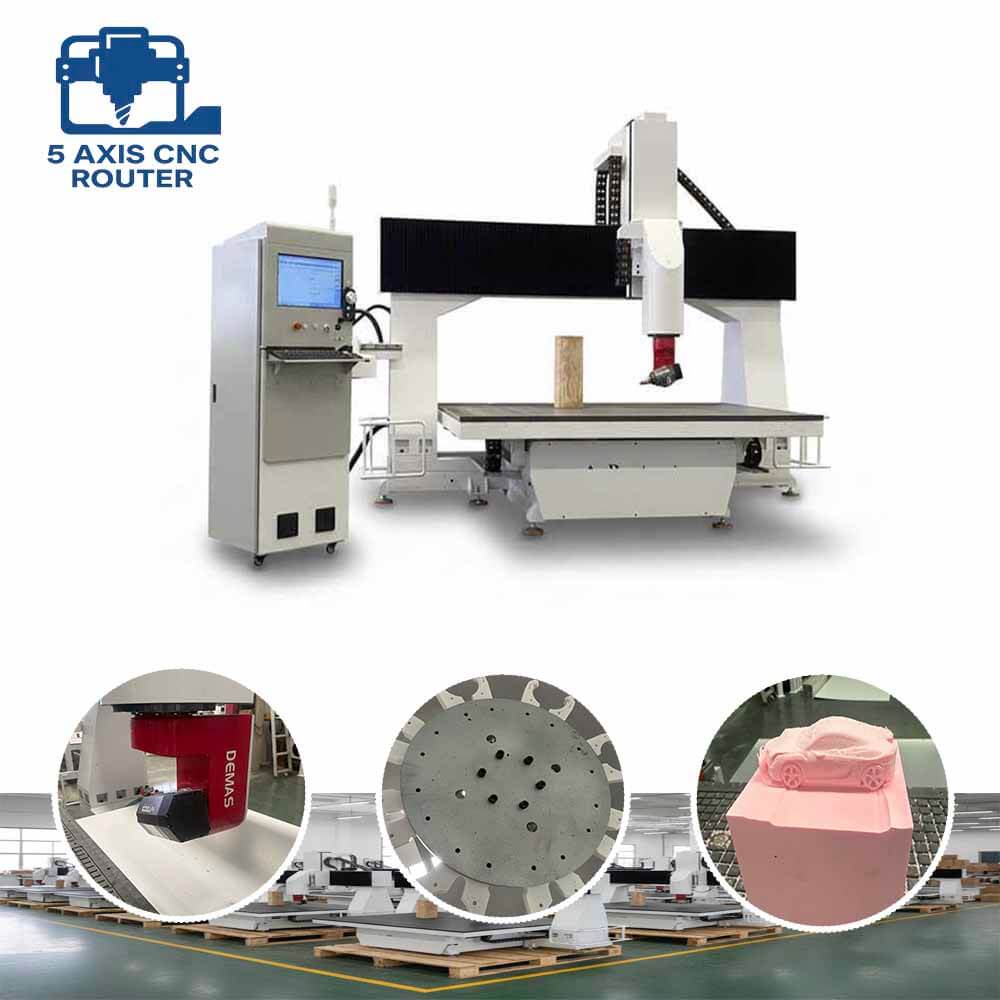
How to Choose the Right 5 Axis CNC Router: A Practical Engineering Checklist
This article is written for engineers, production managers, and workshop owners who need to make a rational equipment decision—not a marketing-driven one.
Many buyers assume that choosing a 5 axis CNC router is simply a matter of:
-
Working size
-
Spindle power
-
Price
In reality, most purchasing mistakes happen because the wrong technical criteria were prioritized.
A 5 axis CNC router is not a single technology—it is a system composed of mechanics, kinematics, control logic, and process capability.
This article provides a practical engineering checklist to help you select the right machine for your actual production needs.
Table of Contents
1. Start With Part Geometry, Not Machine Specifications
Ask This First:
-
What shapes do you actually machine?
-
Are undercuts or compound angles required?
-
Is continuous surface finishing critical?
Engineering Rule:
If your parts can be completed with indexed machining (3+2), a full 5 axis may not be necessary.
Typical Use Cases That Justify 5 Axis
-
Freeform mold surfaces
-
Sculpted furniture components
-
Aerospace composite trimming
-
Multi-angle deep cavities
If your current bottleneck is setup time, not geometry, indexed 5 axis may already solve the problem.
2. Understand the Kinematic Structure (This Is Critical)
Not all 5 axis CNC routers move the same way.
Common Configurations
-
RTCP Gantry Type (A/C head)
-
Tilting Spindle Head + Rotary Table
-
Dual Rotary Head (A/B)
What Matters in Practice
-
Axis stacking height (affects rigidity)
-
Center-of-rotation stability
-
Tool length sensitivity
Engineering Insight
Machines with poorly optimized kinematic centers may lose accuracy when the spindle tilts—especially during deep cutting.
Always request:
-
Kinematic diagram
-
RTCP calibration method
3. Rigidity Matters More Than Axis Count
A 5 axis CNC router with weak structure will:
-
Vibrate during angled cuts
-
Lose surface consistency
-
Reduce tool life
Structural Areas to Evaluate
-
Gantry beam cross-section
-
Column thickness
-
Head mounting interface
Practical Tip
A rigid 3 axis machine outperforms a flexible 5 axis machine in many real-world cases.
If the supplier avoids discussing:
-
Weight distribution
-
Finite stiffness
-
Structural damping
That is a red flag.
4. Spindle Selection: Torque Curve > Horsepower
Common Buyer Mistake
Choosing the highest kW spindle without checking:
-
Torque at low RPM
-
Cooling method
-
Continuous duty rating
For 5 Axis Routing
You should focus on:
-
Stable torque during angled engagement
-
Low vibration at high tilt
-
Bearing preload quality
Typical Recommendations
-
Wood & foam: high-speed spindle with stable bearings
-
Aluminum & composites: torque-focused spindle with lower max RPM
5. Control System Compatibility (CAM Comes First)
A capable 5 axis machine is useless if:
-
Your CAM postprocessor is unstable
-
RTCP is not properly supported
-
Toolpath simulation is unreliable
Ask These Questions
-
Which CAM systems are officially supported?
-
Is RTCP native or macro-based?
-
Can you simulate full 5 axis motion?
Engineering Reality
Control software limitations are one of the most common causes of failed 5 axis projects.
6. Accuracy: Know Which Numbers Matter
Manufacturers often advertise:
-
±0.01 mm positioning accuracy
But rarely explain:
-
Volumetric accuracy
-
Angular repeatability
-
Accuracy under load
What You Should Ask For
-
Ballbar test reports
-
Rotary axis repeatability
-
Accuracy after spindle tilt
7. Automation and Setup Efficiency
A 5 axis CNC router’s value increases dramatically when:
-
Tool length measurement is automated
-
RTCP calibration is repeatable
-
Fixture changes are minimized
Practical Features That Matter
-
Tool length sensor accuracy
-
Rotary axis homing stability
-
Repeatable work offsets
8. Service, Calibration, and Long-Term Support
Long-Term Reality
5 axis machines require:
-
Periodic kinematic calibration
-
Rotary axis maintenance
-
Control updates
Before Buying, Confirm
-
Who performs calibration?
-
Are spare parts standardized?
-
Is remote diagnostic support available?
9. Cost Analysis: Look Beyond Purchase Price
True Cost Components
-
CAM licensing upgrades
-
Training time
-
Tooling wear
-
Initial productivity dip
Frequently Asked Questions
1. Is a full 5 axis CNC router always better than 3+2?
No. If continuous motion is not required, indexed machining is often more stable and economical.
2. How important is RTCP?
Critical. Without stable RTCP, true 5 axis accuracy cannot be maintained.
3. What materials benefit most from 5 axis routing?
Complex wood components, molds, composites, foam, and some aluminum applications.
4. How long does it take to master 5 axis machining?
Typically 3–6 months for experienced operators.
5. Can a weak frame be compensated by software?
No. Structural rigidity cannot be corrected digitally.
6. Should small workshops buy 5 axis machines?
Only if part geometry or setup reduction clearly justifies the complexity.
Conclusion
A 5 axis CNC router is not a shortcut to better machining.
It is a multiplier—for better or worse.
When selected correctly, it:
-
Reduces setups
-
Improves surface quality
-
Expands design capability
When selected poorly, it:
-
Increases complexity
-
Raises costs
-
Delays production
Engineering-driven selection—not marketing—is the only reliable path.
Products Categories
Recently News


Why Choose Us
1.Experienced CNC manufacturer.
2.Strong R&D and innovation.
3.High-quality machine components.
4.Custom solutions available.
5.Strict quality control.
6.Fast production and delivery.
7.Professional technical support.
8.Competitive factory pricing.
9.Trusted by global customers.
10.One-stop CNC solutions.
Contact Us
- Wechat: ExtraCNC
- Whatsapp/Moblie:0086 15562628072
- Email: [email protected]
 EN
EN  AR
AR  EO
EO  IT
IT  DE
DE  KO
KO  JA
JA  RU
RU  AZ
AZ  BG
BG  CS
CS  DA
DA  EL
EL  ES
ES  FR
FR  ID
ID  LV
LV  NL
NL  ML
ML  PT
PT  TT
TT  SL
SL  TH
TH  UZ
UZ  UK
UK  SV
SV  TR
TR