
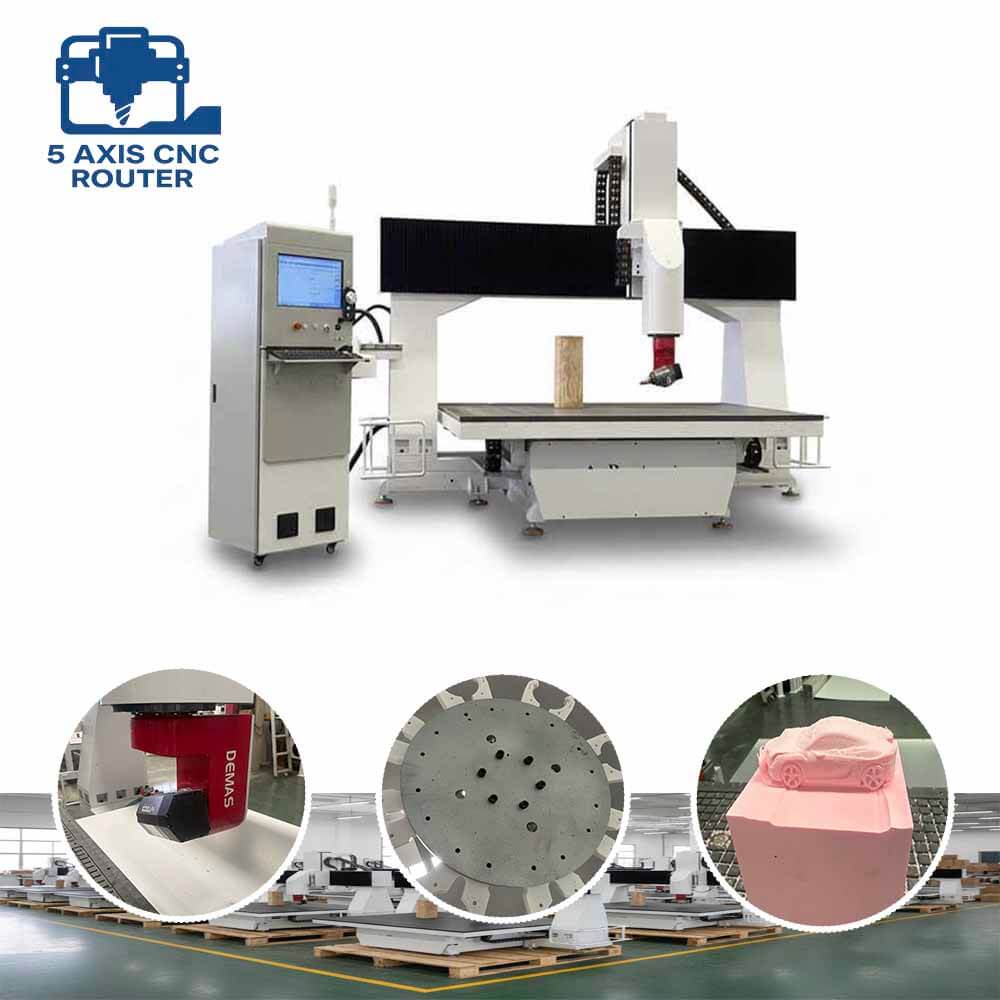
Is a True 5 Axis CNC Router Worth the Investment?
After understanding what a true 5 axis CNC router is and acknowledging its disadvantages, the remaining question for most manufacturers is straightforward but difficult:
This article approaches that question from a practical engineering and financial perspective. Instead of focusing on machine specifications, it evaluates return on investment (ROI), operational impact, and risk — the factors that ultimately determine whether a 5 axis purchase succeeds or fails.
Table of Contents
What “Worth the Investment” Really Means
A true 5 axis CNC router is not judged solely by purchase price. Its value must be evaluated across:
Capital expenditure
Process capability improvement
Labor and skill requirements
Production efficiency
Long-term operational stability
In many cases, a machine that is technically impressive may still be a poor investment if its capabilities are underutilized.
The Cost Structure of a True 5 Axis CNC Router
Initial Investment Components
Beyond the base machine, total investment typically includes:
Advanced CNC control system
High-precision rotary axes
True 5 axis CAM software licenses
Post-processor customization
Operator and programmer training
Installation and calibration
These costs often exceed initial expectations, especially for first-time 5 axis users.
Where ROI Comes From in 5 Axis Machining
A true 5 axis CNC router generates ROI primarily by changing how parts are manufactured, not by running faster.
1. Reduced Setup Count
Single-setup machining can:
Reduce fixture costs
Improve positional accuracy
Shorten overall lead time
2. Increased Geometric Capability
The ability to machine complex surfaces in-house can:
Eliminate outsourcing costs
Shorten design-to-production cycles
Improve design flexibility
3. Improved Surface Quality
Continuous tool orientation reduces:
Manual finishing
Rework
Scrap due to surface defects
These gains accumulate over time rather than appearing immediately.
When ROI Is Often Overestimated
ROI projections commonly fail when:
Parts do not truly require continuous 5 axis motion
Production volumes are low
CAM programming time outweighs setup savings
Operators lack sufficient training
In these cases, machine utilization remains low, delaying or eliminating return on investment.
The Learning Curve Factor
A true 5 axis CNC router introduces a non-linear learning curve.
Early-stage challenges include:
Conservative cutting strategies
Longer programming cycles
Frequent simulation and verification
Productivity gains often appear only after:
CAM workflows stabilize
Operators gain confidence
Process standards are established
In-House 5 Axis vs Outsourcing Complex Parts
For many manufacturers, the investment decision depends on outsourcing economics.
In-House Advantages
Shorter lead times
Better IP protection
Greater process control
Outsourcing Advantages
No capital investment
Access to specialized expertise
Lower risk for low-volume parts
A true 5 axis CNC router becomes attractive when outsourcing costs are recurring and predictable.
Risk Factors That Affect Investment Success
Key risks include:
Underestimating CAM complexity
Insufficient operator training
Poor machine-to-application matching
Lack of long-term service support
Mitigating these risks often matters more than choosing the lowest-priced machine.
Who Should Seriously Consider a True 5 Axis CNC Router
A true 5 axis investment is typically justified when:
Part geometry requires continuous surface machining
Setup reduction directly improves accuracy
Skilled technical staff are available or trainable
Production demand is stable
Long-term capability expansion is strategic
Who Should Think Carefully Before Buying
Caution is advised if:
- Parts are mostly planar or indexed
- Production volumes are small or inconsistent
- Skilled CAM resources are limited
- Budget constraints restrict training and support
In such cases, simpler configurations may deliver better overall results.
Frequently Asked Questions
How long does it take to see ROI on a true 5 axis CNC router?
Typically several months to over a year, depending on utilization and learning curve.
Is a true 5 axis CNC router always better than outsourcing?
No. Outsourcing may be more economical for low-volume or specialized parts.
Can small companies justify a true 5 axis investment?
Yes, if part complexity and production demand support it.
Does 5 axis machining reduce labor costs?
It can reduce setup labor but may increase programming labor.
Is it risky to be a first-time 5 axis buyer?
There is risk, but it can be managed with proper training and realistic expectations.
Conclusion
A true 5 axis CNC router is neither a guaranteed upgrade nor an unnecessary luxury. Its value depends entirely on how closely its capabilities align with real production requirements.
The most reliable investment decisions are made by evaluating:
- Part geometry
- Process bottlenecks
- Organizational readiness
- Long-term manufacturing strategy
When these factors align, a true 5 axis CNC router can become a foundational asset. When they do not, the same machine can remain underutilized despite its technical sophistication.
Products Categories
Recently News


Why Choose Us
1.Experienced CNC manufacturer.
2.Strong R&D and innovation.
3.High-quality machine components.
4.Custom solutions available.
5.Strict quality control.
6.Fast production and delivery.
7.Professional technical support.
8.Competitive factory pricing.
9.Trusted by global customers.
10.One-stop CNC solutions.
Contact Us
- Wechat: ExtraCNC
- Whatsapp/Moblie:0086 15562628072
- Email: [email protected]
 EN
EN  AR
AR  EO
EO  IT
IT  DE
DE  KO
KO  JA
JA  RU
RU  AZ
AZ  BG
BG  CS
CS  DA
DA  EL
EL  ES
ES  FR
FR  ID
ID  LV
LV  NL
NL  ML
ML  PT
PT  TT
TT  SL
SL  TH
TH  UZ
UZ  UK
UK  SV
SV  TR
TR