
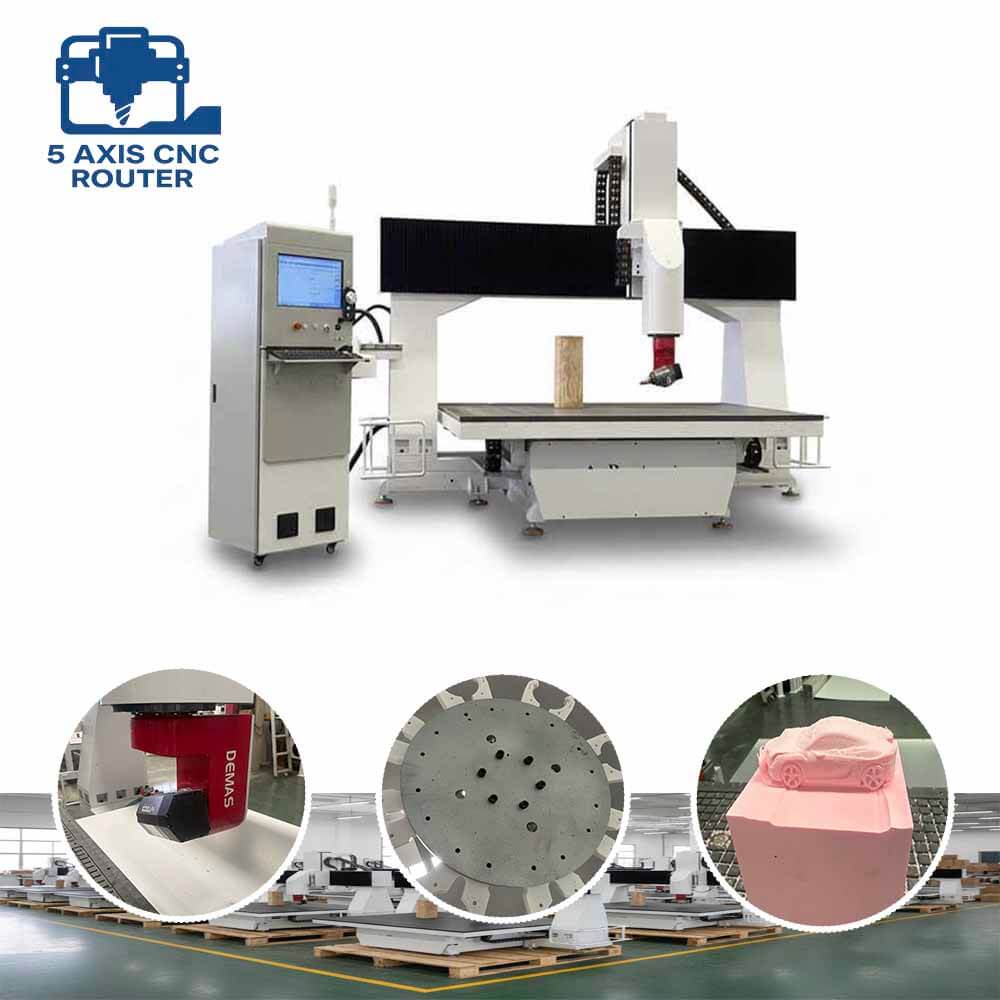
Top 5 Materials for 5 Axis CNC Routers and How to Maximize Production Efficiency
5 axis CNC routers are versatile machines, but their efficiency and output quality depend heavily on the material being machined.
Different materials have unique cutting characteristics, thermal behavior, and surface finish requirements. Selecting the right material and adjusting machining parameters is essential for maintaining accuracy, reducing tool wear, and optimizing production throughput.
This article examines the five most common materials used with 5 axis CNC routers, their machining characteristics, and strategies to maximize efficiency while maintaining precision.
Table of Contents
Medium-Density Fiberboard (MDF)
Material Characteristics
Homogeneous composition, minimal grain
Soft, easily cut with standard carbide tooling
Stable and predictable behavior
MDF is widely used for:
Cabinet panels
Furniture prototypes
Interior architectural elements
Machining Considerations
Feed rates: Moderate to high, depending on bit size
Cutting tools: Flat end mills, compression bits for layered panels
Dust control: Critical due to fine dust particles affecting spindle and work area
Efficiency Strategies
Use climb milling to reduce surface tear-out
Optimize tool paths for continuous curves to minimize air cutting
Batch machining multiple panels reduces tool changes and setup time
Solid Wood
Material Characteristics
Natural variation in grain and density
Hardwoods: Oak, maple, walnut; Softwoods: pine, fir
Susceptible to tear-out if cutting against grain
Solid wood is used for:
Sculpted furniture components
Curved panels
Decorative joinery
Machining Considerations
Feed rates and spindle speed must match wood density and grain orientation
Sharp tooling is essential for clean edges
Tool path planning should account for knots and density variations
Efficiency Strategies
Pre-plan tool paths to minimize abrupt direction changes
Use multi-flute carbide tools to extend life and reduce vibration
For long parts, ensure adequate support to avoid deflection
Aluminum
Material Characteristics
Lightweight, ductile metal with good machinability
Thermal expansion is a factor at high speeds
Common in prototyping, composite tooling, and small production parts
Machining Considerations
High spindle speeds and moderate feed rates
Use coated carbide or HSS tools for longer life
Ensure proper coolant/lubrication to avoid chip welding and thermal expansion
Efficiency Strategies
Minimize air cutting by optimizing tool paths
Avoid unnecessary tool retraction and repositioning
Program simultaneous multi-axis cuts to reduce setups for complex surfaces
Plastics (Acrylic, HDPE, Polycarbonate)
Material Characteristics
Low density, thermally sensitive
Prone to melting or chipping under high speeds
Transparent plastics require careful cutting to avoid surface blemishes
Machining Considerations
Use sharp single-flute or upcut bits to prevent melting
Adjust feed rates to match material thickness and spindle speed
Avoid dwell at the end of cuts to minimize heat buildup
Efficiency Strategies
Batch multiple components to reduce tool changes
Apply air blast or vacuum to remove chips and prevent scratches
Consider climb vs conventional milling based on surface finish requirements
Composites (Carbon Fiber, Fiberglass)
Material Characteristics
Layered structure with anisotropic properties
Abrasive on tools, produces fine dust and fibers
Used for prototypes, tooling, and aerospace components
Machining Considerations
Use diamond-coated or PCD tools to resist wear
Maintain high feed rates to avoid localized heating
Ensure proper dust collection and respiratory protection
Efficiency Strategies
Program optimal cutting angles to minimize delamination
Avoid plunging vertically; use ramping or helical entry
Regularly inspect tools for wear to maintain part accuracy
General Strategies for Maximizing Efficiency Across Materials
Toolpath Optimization
Reduce air cutting and unnecessary retracts
Use high-speed machining strategies for constant engagement
Plan multi-axis motions to minimize rapid changes and vibrations
Tool Management
Use tool life monitoring to schedule replacements proactively
Match tool coatings and geometries to the material being cut
Consider dedicated tooling for high-wear materials like composites
Machine Maintenance
Keep linear guides and rotary axes clean and lubricated
Regular calibration ensures positional accuracy across materials
Monitor spindle condition, especially when machining abrasive composites
Material-Specific Boundary Conditions
| Material | Max Feed Rate | Typical Tooling | Key Considerations |
|---|---|---|---|
| MDF | High | Carbide end mills | Dust collection, climb milling |
| Solid Wood | Moderate | Multi-flute carbide | Grain direction, support for long pieces |
| Aluminum | Moderate | Coated carbide | Thermal expansion, chip evacuation |
| Plastics | Low-Moderate | Single-flute carbide | Avoid melting, surface scratches |
| Composites | Moderate | PCD/diamond | Delamination, abrasive wear, dust control |
Frequently Asked Questions
Which materials are most common on 5 axis CNC routers?
MDF, solid wood, aluminum, plastics, and composites are the most widely used.
Can a single router handle all five materials efficiently?
Yes, with proper tooling, feed rates, and process planning, but abrasive materials like composites may require dedicated tools.
Does material choice affect machine life?
Indirectly, yes. Abrasive or dense materials increase tool wear and stress on machine components.
How do I optimize cutting for surface finish?
Match spindle speed, feed rate, and tool geometry to material properties, and use climb milling where appropriate.
Are there safety concerns with composites?
Yes. Dust is highly abrasive and potentially hazardous; dust collection and PPE are required.
How do I reduce cycle time across different materials?
Batch parts with similar material properties, optimize tool paths, and minimize air cutting movements.
Conclusion
Material selection is a critical factor in determining 5 axis CNC router efficiency. Each material has unique characteristics that affect tool choice, feed rates, spindle speed, and process planning. By understanding these properties and applying material-specific machining strategies, manufacturers can maximize productivity, maintain surface quality, and extend tool and machine life.
Correct material handling and planning are just as important as machine specifications in realizing the full benefits of 5 axis CNC routing.
Products Categories
Recently News


Why Choose Us
1.Experienced CNC manufacturer.
2.Strong R&D and innovation.
3.High-quality machine components.
4.Custom solutions available.
5.Strict quality control.
6.Fast production and delivery.
7.Professional technical support.
8.Competitive factory pricing.
9.Trusted by global customers.
10.One-stop CNC solutions.
Contact Us
- Wechat: ExtraCNC
- Whatsapp/Moblie:0086 15562628072
- Email: [email protected]
 EN
EN  AR
AR  EO
EO  IT
IT  DE
DE  KO
KO  JA
JA  RU
RU  AZ
AZ  BG
BG  CS
CS  DA
DA  EL
EL  ES
ES  FR
FR  ID
ID  LV
LV  NL
NL  ML
ML  PT
PT  TT
TT  SL
SL  TH
TH  UZ
UZ  UK
UK  SV
SV  TR
TR