
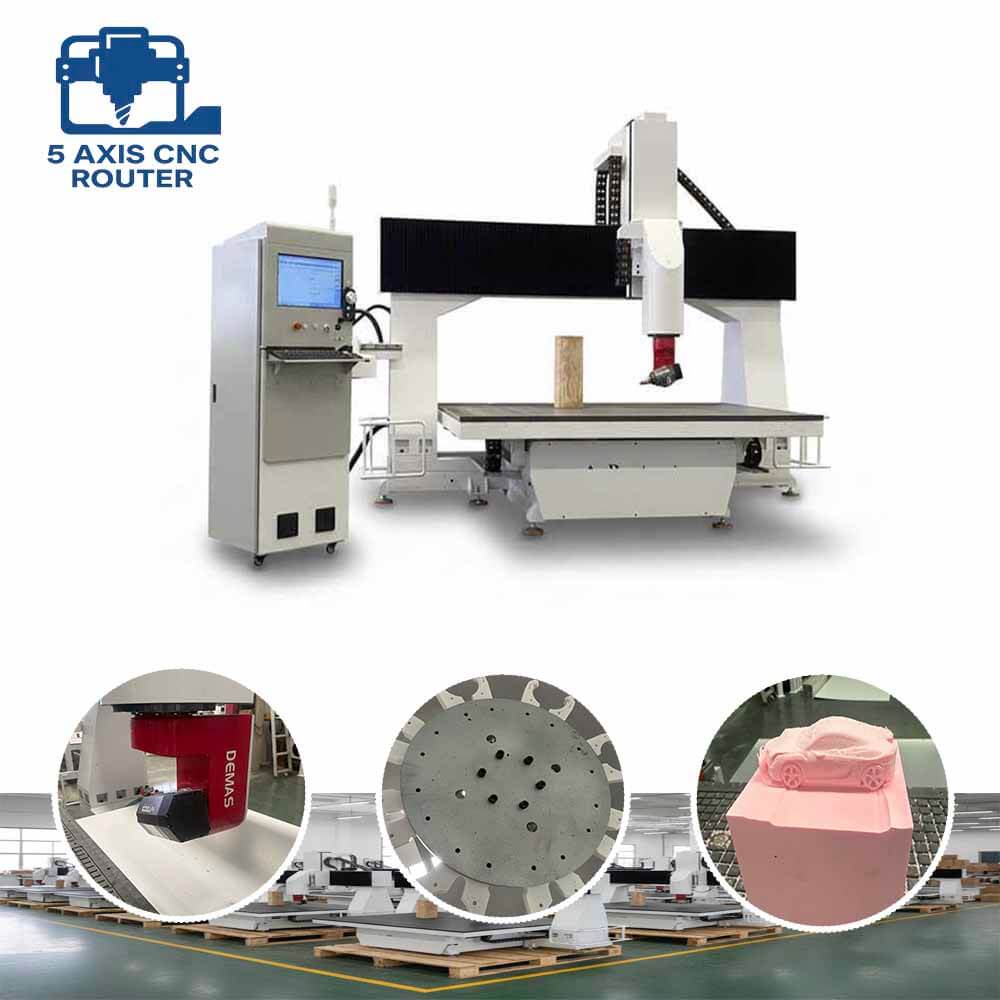
When Do You Really Need a 5 Axis CNC Router?
The question “Do I really need a 5 axis CNC router?” is common among manufacturers, workshop owners, and engineering teams evaluating equipment upgrades. T
The answer is not universal. A 5 axis CNC router is a powerful tool, but its value depends heavily on part geometry, accuracy requirements, production workflow, and long-term manufacturing strategy.
Many companies purchase 5 axis machines too early, before their processes require them. Others delay adoption and struggle with inefficiencies caused by excessive setups, manual rework, or design limitations. This article focuses on identifying clear technical indicators that justify a 5 axis CNC router, and equally important, situations where it may not be the correct solution.
The goal is not to promote 5 axis machining, but to help decision-makers determine whether it solves real production constraints.
Table of Contents
Understanding the Decision Beyond “More Axes = Better”
A common misconception is that more axes automatically mean higher productivity or better quality. In practice, additional axes introduce complexity in programming, fixturing, calibration, and machine dynamics.
From an engineering perspective, the decision to use 5 axis machining should be driven by geometry access, setup reduction, and surface integrity, not by theoretical capability alone.
A 5 axis CNC router becomes valuable when it removes bottlenecks that cannot be efficiently solved with 3 axis or 3+2 axis systems.
Core Scenarios Where a 5 Axis CNC Router Is Justified
1. Complex Curved or Free-Form Surfaces
If your parts include continuous curved surfaces that must maintain consistent surface quality, a 5 axis CNC router provides a clear advantage.
With 3 axis machining, curved surfaces are approximated through layered tool paths. This often results in visible step marks and requires secondary finishing. A 5 axis machine allows the tool to stay normal to the surface, producing smoother results directly from machining.
Typical examples include:
-
Mold cavities with compound curvature
-
Sculpted architectural elements
-
Complex composite molds
When surface integrity directly affects function or downstream processes, 5 axis machining becomes a technical requirement rather than a luxury.
2. Undercuts and Hard-to-Reach Features
Undercut features are one of the most definitive indicators that a 5 axis CNC router may be necessary.
In 3 axis systems, the tool can only approach material from a single vertical direction. Any geometry hidden behind another feature requires manual repositioning or alternative manufacturing methods.
A 5 axis CNC router can tilt the tool or rotate the workpiece, allowing direct access to:
-
Internal contours
-
Reverse angles
-
Deep cavities with side walls
This eliminates manual re-fixturing and reduces cumulative alignment errors.
3. Excessive Setup and Re-Clamping Time
If your production process requires frequent re-clamping of the same part to access different faces, setup time quickly becomes a dominant cost factor.
Each setup introduces:
-
Additional labor
-
Alignment errors
-
Risk of part damage
-
Variability between batches
A 5 axis CNC router allows multiple faces to be machined in a single setup. From a process engineering standpoint, reducing setups often delivers greater efficiency gains than increasing cutting speed.
When setup time exceeds machining time, the case for 5 axis machining becomes strong.
4. Tight Tolerance Requirements Across Multiple Faces
Maintaining tight positional tolerances across multiple surfaces is difficult when parts are repositioned manually.
With each re-clamping, reference points shift slightly. Even with precision fixtures, tolerance stack-up can become significant, especially in multi-surface components.
A 5 axis CNC router maintains a consistent coordinate system throughout the machining process. This improves:
-
Positional accuracy
-
Repeatability
-
Inter-feature alignment
For parts where geometric relationships between faces are critical, this consistency is often more important than raw cutting capability.
5. Tool Access and Tool Life Optimization
In 3 axis machining, tools often operate at suboptimal angles, increasing tool wear and cutting forces. This can lead to:
-
Shorter tool life
-
Poor surface finish
-
Increased vibration
A 5 axis CNC router allows dynamic tool orientation, keeping the cutting edge engaged at optimal angles. From a machining mechanics standpoint, this improves chip evacuation and reduces stress on both tool and spindle.
For long production runs or abrasive materials, improved tool life can significantly reduce operating costs.
Situations Where a 5 Axis CNC Router May NOT Be Necessary
1. Flat Panels and Simple 2.5D Geometry
If your production focuses on flat panels, nested sheet cutting, or simple pocketing operations, a 3 axis CNC router is often more efficient and easier to operate.
Adding extra axes does not improve productivity in these cases and may introduce unnecessary complexity.
2. Low Production Volume with High Programming Overhead
5 axis machining requires advanced CAM programming and skilled operators. For very low production volumes, programming time may outweigh the efficiency gains from reduced setups.
In such cases, simpler machines with manual intervention may be more cost-effective.
3. Heavy Steel Machining Requirements
Most CNC routers—including 5 axis models—are optimized for wood, composites, plastics, and non-ferrous metals. If your primary application involves heavy steel cutting, a machining center rather than a CNC router is typically more appropriate.
Machine rigidity and spindle characteristics matter more than axis count in these scenarios.
3 Axis vs 3+2 Axis vs 5 Axis: Decision Comparison
When 3 Axis Is Sufficient
-
Flat or shallow geometry
-
Single-face machining
-
Minimal tolerance interaction
When 3+2 Axis Makes Sense
-
Angled features with fixed orientations
-
Limited undercuts
-
Moderate complexity
When True 5 Axis Is Required
-
Continuous curved surfaces
-
Multiple undercuts
-
Tight multi-face tolerances
-
Setup reduction is critical
Understanding where your parts fall within this spectrum is essential to making a rational equipment decision.
Operational and Skill Considerations
Adopting a 5 axis CNC router also changes operational requirements.
Key considerations include:
-
CAM software capability
-
Post-processor quality
-
Operator training
-
Maintenance and calibration procedures
A 5 axis machine does not compensate for weak process control. Without proper workflows, its advantages may not be fully realized.
Long-Term Manufacturing Strategy Perspective
From a strategic standpoint, a 5 axis CNC router enables greater design freedom. Engineering teams are no longer constrained by tool access limitations, which can influence product design and innovation.
However, this flexibility should align with long-term production goals. Purchasing a 5 axis machine without a clear roadmap often results in underutilization.
Frequently Asked Questions
When does a 5 axis CNC router become necessary?
When part geometry, tolerance requirements, or setup reduction cannot be efficiently achieved with 3 axis or 3+2 axis machines.
Can a 3+2 axis machine replace a true 5 axis router?
In some cases, yes. However, it cannot perform continuous multi-axis machining or achieve the same surface quality on complex curves.
Is 5 axis machining always faster?
Not always. While it reduces setups, programming and toolpath optimization may increase preparation time.
Does a 5 axis CNC router improve accuracy?
It improves positional consistency across multiple faces by eliminating re-clamping, but overall accuracy still depends on machine rigidity and calibration.
Is operator skill more important in 5 axis machining?
Yes. Proper CAM programming and understanding of multi-axis kinematics are essential for stable and accurate results.
Can all CAM software handle 5 axis machining?
No. True 5 axis machining requires advanced CAM systems with reliable collision detection and post-processing.
Conclusion
A 5 axis CNC router is not a universal upgrade, but a targeted solution to specific manufacturing challenges. It becomes necessary when geometry complexity, surface quality, setup reduction, and tolerance consistency are limiting production efficiency.
Understanding why and when to adopt 5 axis machining ensures that investment decisions are driven by real engineering requirements rather than assumptions.
Products Categories
Recently News


Why Choose Us
1.Experienced CNC manufacturer.
2.Strong R&D and innovation.
3.High-quality machine components.
4.Custom solutions available.
5.Strict quality control.
6.Fast production and delivery.
7.Professional technical support.
8.Competitive factory pricing.
9.Trusted by global customers.
10.One-stop CNC solutions.
Contact Us
- Wechat: ExtraCNC
- Whatsapp/Moblie:0086 15562628072
- Email: [email protected]
 EN
EN  AR
AR  EO
EO  IT
IT  DE
DE  KO
KO  JA
JA  RU
RU  AZ
AZ  BG
BG  CS
CS  DA
DA  EL
EL  ES
ES  FR
FR  ID
ID  LV
LV  NL
NL  ML
ML  PT
PT  TT
TT  SL
SL  TH
TH  UZ
UZ  UK
UK  SV
SV  TR
TR